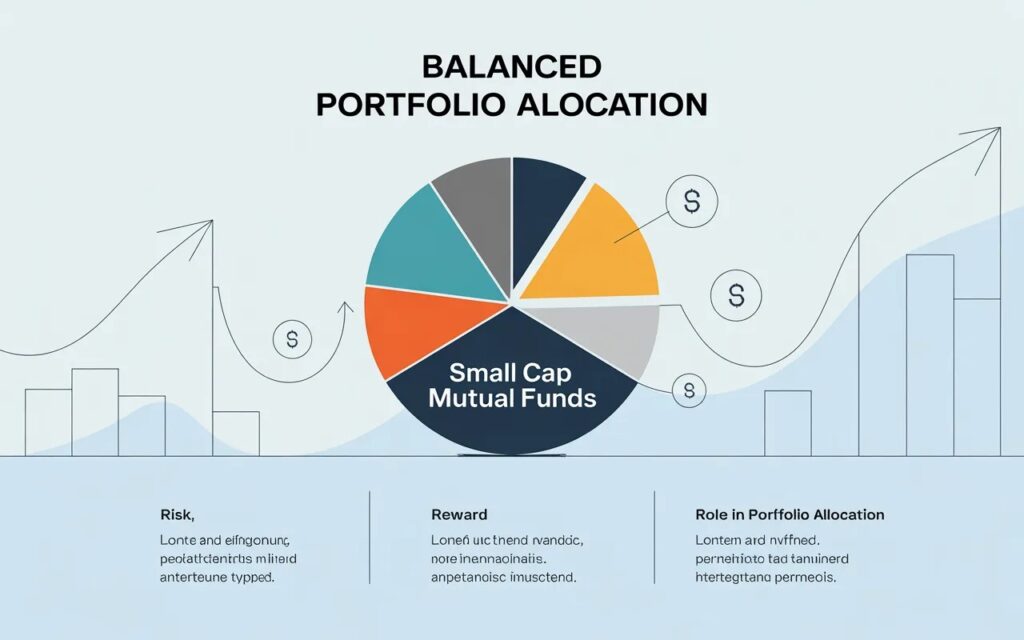
Small-cap mutual funds have always attracted a certain kind of investor, those willing to tolerate short-term discomfort in pursuit of long-term wealth creation. Over the years, these funds have delivered some of the highest returns across market cycles, but not without testing investor patience and discipline.


This article takes a balanced, experience-driven look at small-cap mutual funds, covering their risk profile, return potential, and most importantly, how they should be positioned within a
well-constructed investment portfolio.
What Are Small-Cap Mutual Funds?
Small-cap mutual funds invest primarily in companies that fall under the small-cap category as defined by SEBI. These are companies ranked beyond the top 250 stocks by market capitalization in India.
Key Characteristics of Small-Cap Stocks
- Early or mid-stage businesses with high growth potential
- Lower market visibility and analyst coverage
- Higher sensitivity to economic and market cycles
- Limited liquidity compared to large and mid-cap stocks
Small-cap funds aim to identify such businesses early and benefit from their long-term growth as they scale operations and improve profitability.
Why Small Cap Mutual Funds Offer Higher Return Potential
Historically, small-cap funds have outperformed large-cap and mid-cap funds during extended bull markets. The reason lies in earnings growth and valuation re-rating.
Growth Advantage
Small companies operate on a lower base. Even modest improvements in revenue, margins, or market share can lead to exponential growth in profits and, consequently, stock prices.
Re-rating Opportunity
As businesses mature and gain investor confidence, their valuation multiples expand. This re-rating contributes significantly to long-term returns in small-cap investing.
Active Fund Management Edge
Unlike large caps, small caps are less efficiently priced. Skilled fund managers can add meaningful alpha through:
- Bottom-up stock selection
- Early identification of emerging leaders
- Avoiding weak governance and balance sheets
Understanding the Risks in Small-Cap Mutual Funds
While the return potential is attractive, small-cap mutual funds carry structural risks that investors must understand before allocating capital.
Higher Volatility
Small-cap funds experience sharper price swings during market corrections. Drawdowns of 30–40% during bear phases are not uncommon.
Liquidity Risk
Many small-cap stocks trade in low volumes. During periods of market stress, fund managers may find it difficult to exit positions without impacting prices.
Business and Governance Risk
Smaller companies are more vulnerable to:
- Management execution failures
- Corporate governance issues
- Funding and cash flow constraints
Performance Cyclicality
Small-cap funds tend to underperform during:
- Economic slowdowns
- Tight liquidity environments
- Rising interest rate cycles
These risks make small-cap funds unsuitable for short-term or tactical investing.
Risk vs Reward: Is the Trade-Off Worth It?
From a long-term perspective, the risk-reward equation of small-cap mutual funds can be favourable, but only for the right investor.
When Small-Cap Funds Reward Investors
- Investment horizon of 7–10 years or more
- Disciplined SIP approach
- Ability to stay invested during prolonged drawdowns
- Portfolio diversification across asset classes
When They Can Destroy Value
- Lump sum investing at market peaks
- Panic selling during corrections
- Overexposure beyond risk tolerance
- Chasing recent top-performing funds
The key takeaway: small-cap funds reward patience, not timing.
Role of Small-Cap Mutual Funds in Portfolio Allocation
Small-cap mutual funds should never form the core of an investment portfolio. Instead, they work best as a satellite allocation.
Ideal Portfolio Positioning
- Core: Large-cap funds, index funds, debt instruments
- Satellite: Small-cap and thematic funds
This structure balances stability with growth potential.
Recommended Allocation
While there is no one-size-fits-all rule, a broadly accepted allocation is:
- Conservative investors: 0–5%
- Moderate investors: 5–10%
- Aggressive, long-term investors: 10–15%
Allocations beyond this increase portfolio volatility disproportionately.
SIP vs Lump Sum in Small-Cap Mutual Funds
Timing the small-cap segment is extremely difficult, even for seasoned professionals.
Why SIP Works Better
- Reduces market timing risk
- Average cost during volatility
- Builds discipline during bearish phases
- Aligns with long-term wealth creation goals
Lump Sum: Use With Caution
Lump sum investments may be considered only when:
- Valuations are reasonable
- Market sentiment is pessimistic
- You have surplus capital and a long holding horizon
For most investors, SIP remains the preferred route.
How to Evaluate a Small-Cap Mutual Fund
Selecting the right small-cap fund requires more than looking at past returns.
Key Evaluation Parameters
- Fund manager experience and stability
- Investment philosophy and process
- Portfolio concentration and turnover
- Risk management practices
- Performance consistency across cycles
What to Avoid
- Funds with excessive churn
- Overexposure to illiquid stocks
- Recent outperformers with no long-term track record
Consistency matters more than occasional outperformance.
Taxation of Small-Cap Mutual Funds
From a tax perspective, small-cap mutual funds are treated as equity mutual funds.
Capital Gains Tax
- Short-term (≤ 1 year): 15%
- Long-term (> 1 year): 10% on gains above ₹1 lakh
Tax efficiency further enhances their appeal for long-term investors.
Common Mistakes Investors Make
Even experienced investors fall into predictable traps when investing in small-cap funds.
Frequent Errors
- Chasing last year’s best fund
- Investing without understanding volatility
- Exiting after sharp corrections
- Overallocating due to past returns
Successful small-cap investing is more about behavioural discipline than stock selection.
Are Small-Cap Mutual Funds Right for You?
Small-cap mutual funds are not suitable for everyone. They are best suited for investors who:
- Have a long investment horizon
- Understand market cycles
- Can tolerate interim losses
- Already have a stable core portfolio
If capital preservation or short-term stability is your priority, small-cap funds may not align with your goals.
Final Thoughts
Small-cap mutual funds occupy a unique space in the investment universe. They offer the possibility of superior long-term returns but demand patience, discipline, and emotional resilience.
When used thoughtfully, as a limited allocation within a diversified portfolio, they can significantly enhance wealth creation. When misused or overexposed, they can do the opposite.
For investors looking to track, compare, and understand mutual fund performance more clearly, platforms like Rupeezy can help simplify research and decision-making, especially when navigating volatile segments such as small-cap mutual funds.