


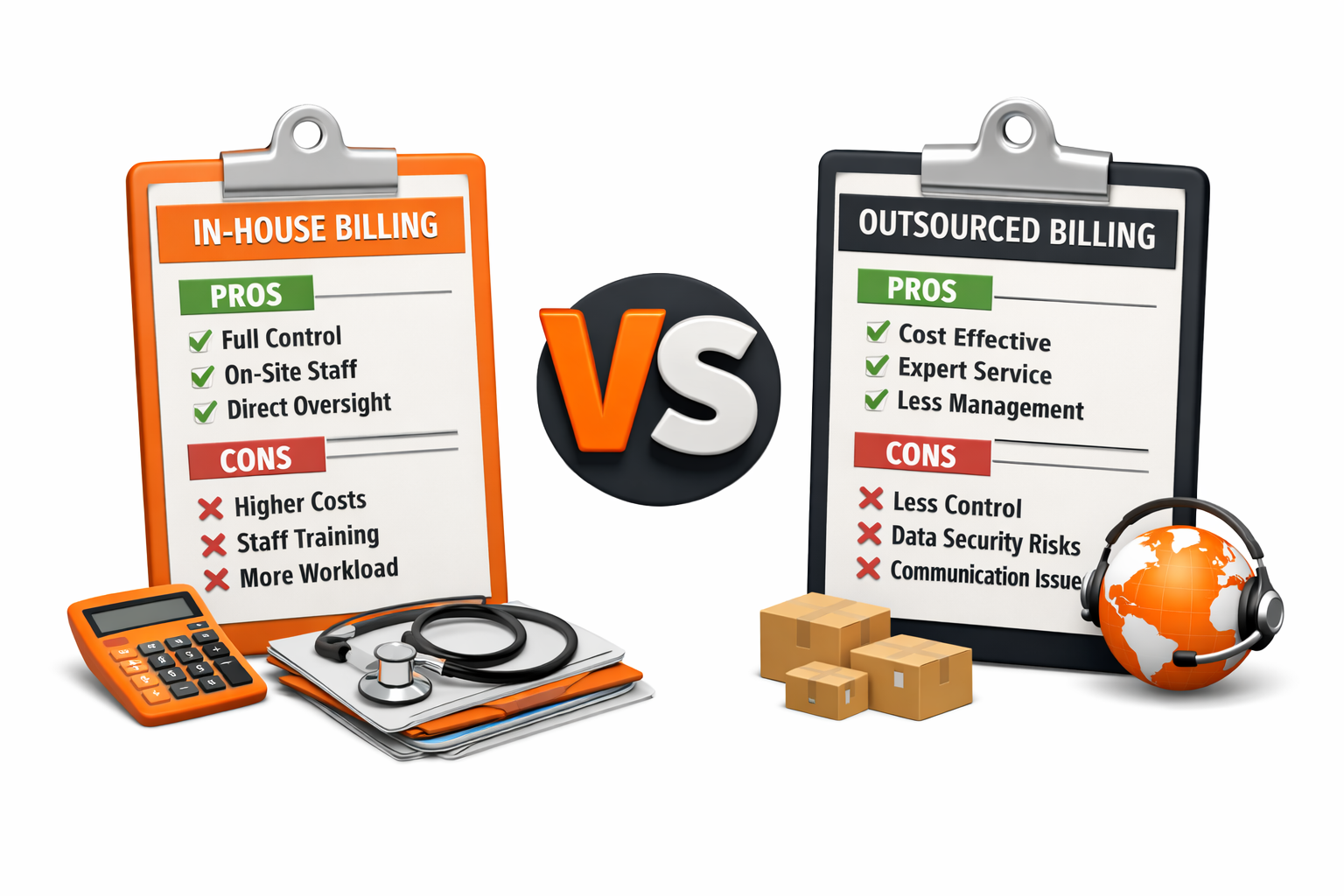
Every healthcare practice reaches this crossroads sooner or later, whether the medical billing should stay inside the organization or move outside. The decision looks simple on paper, but it isn’t simple to make because it directly affects the cash flow, compliance, staff workload, and patient experience.


One choice gives you control and proximity. The other promises scale, expertise, and cost efficiency. So, before you decide on anything, it is essential to understand the pros and cons of in-house versus outsourced medical billing.
What is In-House Medical Billing?
When healthcare providers internally manage their billing, this is referred to as in-house billing. This strategy involves assembling an entire team of billing specialists to manage the entire medical billing and collections process.
In order to implement in-house billing, providers need to invest in a solid framework, billing software, and trained personnel who can navigate the billing intricacies. Managing in-house billing successfully can cost a lot in resource allocation.
What Is Outsourced Medical Billing?
Paying an outside company to handle every stage of the medical billing process is known as outsourced medical billing. This covers all administrative tasks so that your staff can concentrate on patients, from coding visits and confirming coverage to cleaning claims and pursuing payments. You pay specialists who are passionate about revenue cycle management a portion of collections rather than having to hire and train in-house medical billing staff.
The vendor provides you with a secure gateway or links to your electronic health record once you sign a service agreement. Next, they:
- Obtain demographic information
- Verify your eligibility
- Convert notes into compliant codes
In-House Medical Billing Vs. Outsourced Medical Billing
There are a number of advantages and disadvantages to both medical billing outsourcing and internal staff billing assignments. The time management skills of both you and your employees, particularly if they have other responsibilities, as well as your practice’s personnel budget, may be some of the primary factors in selecting one over the other.
| Factor | In-house Medical Billing | Outsources Medical Billing |
| Staff Requirements | Managed by internal staff | Handled by an external billing company |
| Operational Costs | Higher staffing and training costs | Lower upfront operational costs |
| Control | Full control over the billing process | Limited direct control |
| Compliance | Requires ongoing compliance training | Experts stay updated on coding rules |
| Communication and reporting | Faster internal communication | Less daily management is needed |
| Data and privacy | Data remains within the organization | Secured but data shared with third-party vendor |
| Time management | Diverts staff time from patient care | Allows focus on core clinical work |
Cost Comparison: In-House vs. Outsourced Billing
Over time, billing becomes one of the most costly tasks in an expanding practice due to the accumulation of salaries, software, training, claim rework, and delayed payments. Practices often wonder if handling billing internally is still cost-effective or if outsourcing provides better financial control as financial pressure mounts. Here’s how you can make an informed decision:
| Key Aspect | In-House Billing | Outsourced Billing |
| Staffing | Fixed salaries, benefits, and turnover costs | Fee-based. No payroll or HR costs |
| Training | Ongoing certification expenses | Managed by vendor |
| Compliance | Higher audit and penalty risk | Lower risk with expert oversight |
| Cashflow and A/R | A/R cycles average 50-60 days, slowing reimbursements and cash availability. | Faster A/R cycles of 30-40 days improve liquidity and cash flow predictability. |
| Denials | Higher rework and revenue loss | Lower denial rates |
| Technology | Software, IT, upgrades paid separately | Included in the service fee |
Factors to Consider When Choosing the Right Medical Billing Option
Outsourced medical billing services include flexibility, cost savings, and knowledge. However, cautious vendor selection, stringent contracts, and robust data security are crucial to lower risks. Contrarily, maintaining RCM in-house gives you more control, but it costs a lot of money for these resources and expertise.
So, here are some factors that you can consider to make a decision:
- Strategic Alignment: You must evaluate how outsourcing fits into the organization’s long-term growth plans, priorities, and goals.
- Billing Complexity: Experienced medical billing services are preferred by practices with unique billing requirements, such as mental health or cardiology.
- Technology Requirements: Determine if your practice has the funds to purchase and manage cutting-edge billing software.
- Time Management: While outsourcing drastically lowers administrative workload and management effort, in-house medical billing necessitates regular daily supervision and active management involvement.
- Compliance Requirements: In order to lower legal risks, outsourced suppliers frequently do a great job of keeping up with regulatory changes.
- Scalability: As your practice expands, think about how simple it will be to scale billing operations.
Which is Better for Your Healthcare Practice?
The choice between in-house and outsourced billing is a strategic financial choice for healthcare practices. In-house billing necessitates constant investment in personnel, technology, training, and compliance, even while it can offer a sense of control and instant visibility. These fixed expenses may restrict flexibility and put increasing strain on practice margins.
However, a more flexible and economical approach is provided by outsourcing medical billing and coding. Switching to performance-based pricing minimizes exposure to labor shortages and regulatory risk while lowering overhead, increasing claim accuracy, and speeding up payments. For example, CEC is an RCM service provider that ensures a 99% clean claim submission rate, and within 6 months, the A/R aging can be reduced by 50%.
Instead of absorbing erratic administrative costs, this strategy enables practices to correlate billing costs with revenue performance directly. Outsourcing helps practices be financially secure, operationally effective, and patient-centered even as billing complexity rises.
Final Thoughts
The decision between in-house and outsourced medical billing is based on the objectives, financial constraints, and operational capabilities of your practice. However, outsourcing is becoming a more sensible and long-term strategy for practices of all sizes as the healthcare industry gets more complicated.
When healthcare practices collaborate with leading medical billing firms, like CEC, which has been assisting healthcare providers in maximizing revenue consistently, then you can rest assured that your billing will be handled with accuracy and accountability.
In-House vs. Outsourced Medical Billing FAQs
Which billing model will be simpler to budget for?
Because expenses scale with collections rather than staying constant, outsourced billing is simpler to budget for.
Does in-house billing cost more when there are fewer patients?
Even when collections drop, fixed staffing and software expenses don’t change.
Is billing outsourcing a long-term or short-term cost strategy?
Generally speaking, outsourcing is a long-term approach to sustainable billing costs.
Which billing model is more compatible with growth-oriented practices?
The scalable, performance-based cost structures of outsourced billing make it more compatible with expansion.









