


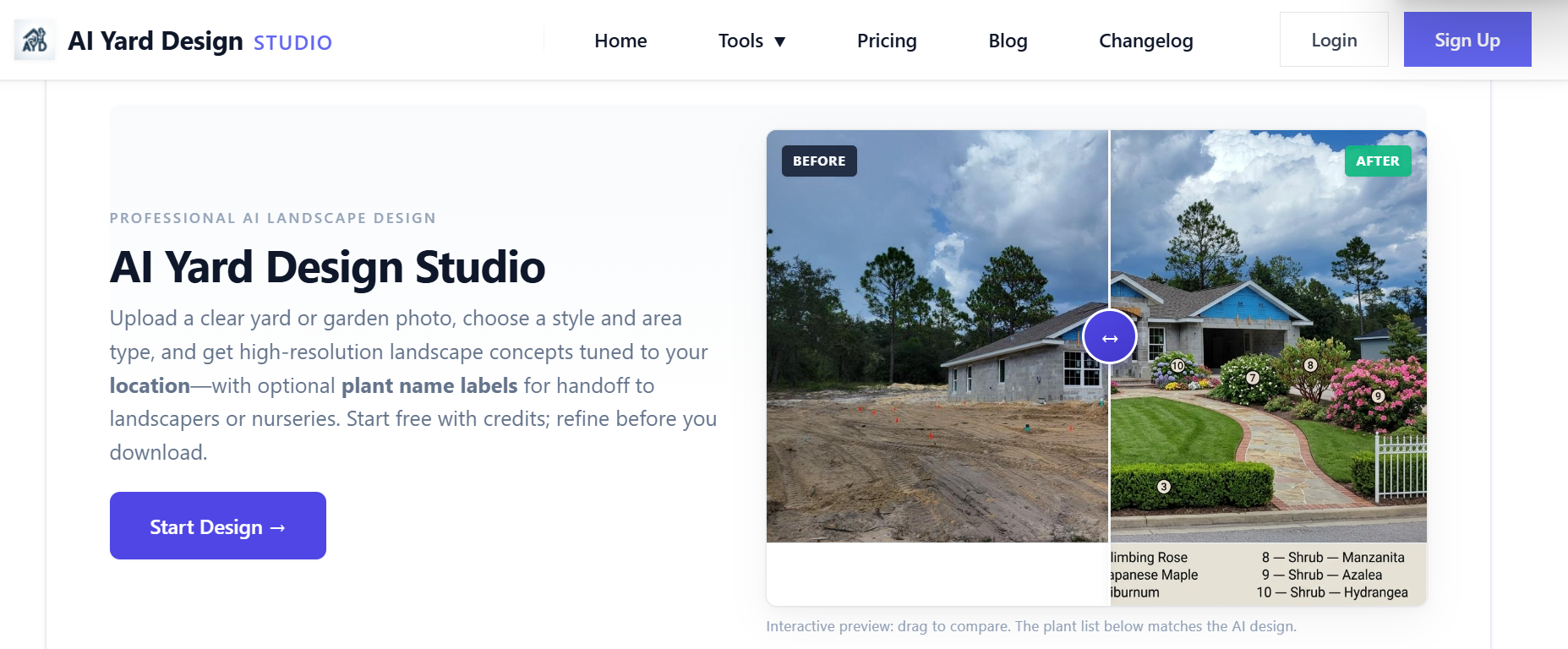
Outdoor projects rarely fail because homeowners lack inspiration. They fail because inspiration is not anchored to the same yard. People agree in words while imagining different futures. Contractors ask practical questions that expose missing priorities. Nurseries hear adjectives that do not map to plants. And once hardscape and irrigation decisions harden, changes stop being a conversation and start becoming a change order. AI Yard Design Studio exists to shorten that expensive misalignment phase. It is a residential-focused workflow for turning a real yard or garden photograph into iterable, shareable landscape concepts—so you can compare directions while you still have flexibility. This is a practical form of AI landscape design: less “pretty fantasy,” more site-grounded visualization you can react to as a household and discuss with pros.


Start from the lot you actually own
The Studio begins where your property begins: an uploaded image. If you hide your fence line, your slope, your mature trees, or your existing paving, you are effectively asking any generative system to invent a different address. If you include context—house relationship, boundaries, key vertical elements, and hardscape you may keep—outputs become easier to critique as yours. You can also learn the workflow using sample images if you do not have a photo handy yet. The point is the same: AI Yard Design Studio is designed to reward honest inputs, because outdoor design is a constraints game.
Zone-first planning: front yard problems are not backyard problems
AI Yard Design Studio organizes generation around home-scale outdoor zones—front yard, backyard, side yard, garden retreats, and pool surrounds—because each zone implies different priorities: curb appeal and arrival, private outdoor living, narrow circulation, intimate planting rhythm, and water-adjacent safety and materials. If you mix those jobs into one vague brief, you get vague results. If you name the zone correctly, you get comparisons that feel like real planning—not a random mood board.
Turn style into a real brief (not just a vibe)
Beyond area type, AI Yard Design Studio asks for a required style direction, then lets you add optional elements and plain-language requirements. This is where homeowners win or lose: style is not a substitute for constraints. Write the non-negotiables the way a landscaper can understand them: keep a specimen tree, need screening along a property line, low-maintenance priorities, dog paths, no standing water, a hard “no” list for features you refuse. The Studio treats those notes as part of the brief, not decoration.
Optional location context for more believable outdoor outcomes
A common AI failure mode is climate fantasy: the right look for the wrong region. AI Yard Design Studio includes optional location context to steer planting palettes and materials toward outcomes that feel more appropriate where you live. Hold the right expectation: this is a realism lever, not a guarantee. The platform does not replace nursery inventory checks, invasive-species diligence, or local professional judgment. It reduces the gap between “internet beautiful” and “plausible in my area with reasonable care.”
Staged outputs: explore first, present when you are ready
AI Yard Design Studio separates fast layout exploration from higher-detail concepts you can share. A quicker draft tier is built for comparing circulation, openness versus enclosure, and hardscape versus planting emphasis—without paying for a meeting-ready render too early. When you need sharper detail, a higher-quality tier targets a more presentation-grade image and may include on-image plant callouts. Treat those callouts as reference prompts for conversation, not botanical certification—mature size, winter hardiness, water needs, and availability still require human verification. Credits and resolution choices are part of the product’s transparency: iterate cheaply while ideas are fluid, then invest when you have a direction worth sharing. If you want the public-facing details to stay perfectly current, cross-check the generator page and FAQ on ai-yard-design.com as you publish—outdoor AI products evolve quickly.
Fine-tune in layers instead of restarting from zero
Outdoor design is iterative: hardscape logic, then planting structure, then accents. AI Yard Design Studio supports fine-tuning—adjust pathway materials, planting emphasis, and common outdoor amenities—plus custom instructions for the one change that must land without throwing away a mostly-right concept. That workflow matches how real projects progress. The Studio is built for disciplined iteration, not endless resets.
When your project is bigger than a home lot
AI Yard Design Studio is not the right mental model for every outdoor problem. Large sites—parks, campuses, commercial grounds, streetscapes—require a different scale of circulation, maintenance thinking, and stakeholder communication. The platform provides a separate large-scale landscape lane so you do not force a campus brief through a backyard form. Scale honesty is a trust signal. If a tool claims one button solves every outdoor environment on earth, you should be skeptical.
Try it this week: a simple workflow
If you want AI landscape design to stay grounded, run this sequence:
- Take a contextual yard photo (or start from a sample while learning).
- In AI Yard Design Studio, choose the correct zone and a coherent style direction.
- Add elements and written requirements like a real brief.
- Include location context if plant believability matters to you.
- Generate a draft pass to compare directions, then move to higher detail when you are ready to share.
- Fine-tune in layers, and verify planting and construction assumptions locally.
To open the interactive generator directly, start with ai-yard-design.com and upload a truthful outdoor photo.
Conclusion: align early, spend wisely
AI Yard Design Studio is not a promise that your yard transforms overnight. It is a promise that planning can start smarter: earlier agreement, fewer circular conversations, and a shared image that respects your photo, your zone, and your stated constraints. If you are comparing tools, prioritize site grounding, zone clarity, staged quality, climate realism, safe labeling, structured refinement, and scale fit. Those are the differences that separate useful AI landscape design from disposable renders—and they are the differences the Studio is built around. When you are ready to validate the latest workflow details and policies for yourself, use the live documentation and generator experience at ai-yard-design.com.









