
Intro: The “Impossible Triangle” in Digital Marketing—and How AI Breaks It


Marketing teams are currently running into a structural constraint: video demand keeps rising, while production capacity (time, budget, and headcount) does not. On the demand side, competition continues to intensify. The IAB/PwC Internet Advertising Revenue Report shows U.S. digital advertising revenue reached roughly $259B in 2024, up about 15% year over year. More spend in the system doesn’t automatically translate into more creative supply—if anything, it raises the bar for content volume and iteration speed.
Meanwhile, video consumption and distribution are accelerating. Wistia’s ecosystem data indicates that video plays increased by 15% and total watch time surged by 44%. That growth comes with a familiar operational consequence: content fatigue. Audiences scroll faster, platforms reward freshness, and advertisers must refresh creatives more frequently to avoid performance decay.
Traditional production workflows—brief → script → shoot → edit → review → resize—struggle to match that cadence. In fact, time and bandwidth (61%) are cited as the number one barrier to producing more video, ranking ahead of budget constraints. This creates the modern “impossible triangle” of performance marketing: speed, cost, and quality rarely move together. As teams push harder on A/B testing to find winners, they often lose the testing window because production cycles and approvals move too slowly.
This is where an ad video generator should be framed not as “AI replacing editors,” but as a redesign of the creative supply chain. By automating standardized elements—script structure, pacing, captions, voiceover, and asset matching—AI tools help teams reserve scarce human attention for higher-leverage decisions: positioning, creative direction, and measurement loops.
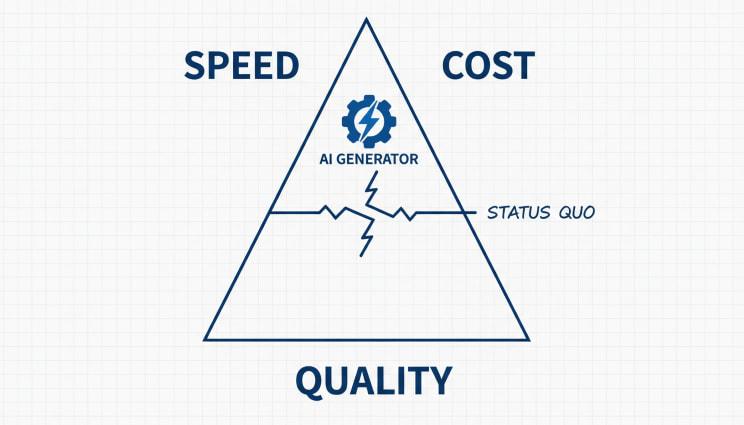
alt: Diagram showing the impossible triangle of video marketing: Speed, Cost, and Quality, solved by an ad video generator.
Deconstructing the Core Tech: The Functional Logic of a Modern AI Ad Generator
Early tools were largely template-based “stitching.” A modern AI ad generator is different: it shifts from manipulating video files to understanding marketing intent and language. Instead of merely generating visuals, it translates “value proposition → audience → scenario → CTA” into an executable ad structure.
In practice, a capable ad video generator typically centers on three core capabilities:
1. Script Generation (Script-to-Video)
Given product information, landing-page copy, or campaign objectives, the system drafts a script framework and scene plan: hook, problem framing, solution, proof, and CTA. For teams running frequent tests, this turns script ideation into a reusable component—one reason an ad video generator fits performance workflows perfectly.
2. Digital Presenters and Controllable Voice Assets
For multi-market campaigns, voice consistency is often underestimated. Different creators and agencies introduce style drift and brand inconsistency. With AI voice or digital presenters, these tools turn voice assets into versioned, reusable content—essential for categories requiring strict tone control (beauty, consumer electronics, SaaS).
3. Intelligent B-roll Matching and Automated “Visual Language”
In short-form advertising, B-roll determines information density and pacing. Modern systems can match assets to script semantics—product close-ups, usage scenarios, comparisons, social proof—reducing the time spent searching for footage. More importantly, it makes “visual language” repeatable as a rule set, not an artisanal process rebuilt each time.
Together, these capabilities define why an ad video generator matters commercially: it’s not a single feature—it’s a creative supply mechanism that plugs directly into the ad system.
From Theory to Practice: Where AI Video Tools Create Operational Value
The best use of an ad video generator is rarely “make one perfect video.” It is to produce low-cost, high-coverage variants for each funnel stage—so distribution and creative iteration form a closed loop.
Use Case 1: E-commerce Product Showcases (Scaling SKUs)
For e-commerce brands, the bottleneck is operations: too many products, fragmented assets, and platform-specific formats (9:16, 1:1, 16:9). Manual editing often collapses under scheduling and revision cycles.
When deployed as an AI product video maker, speed gains typically come from three levers:
- Batchable structure: Category-level storyboards (3-second hook → benefits → scenario → CTA) reduce “from-zero” assembly.
- Controlled detail: Product photos, specs, and benefits are translated into scene sequences while maintaining brand rules (fonts, colors, layout).
- Versioned outputs: The same SKU generates multiple variants (different hooks, benefit order, CTAs), supporting PDP videos and paid social creative with a unified supply.
alt: An AI product video maker automatically resizing one e-commerce SKU into TikTok, Instagram, and YouTube formats.
Use Case 2: Paid Social Performance (High-Frequency A/B Testing)
Short-form platforms like TikTok and Reels create a hard truth: creative is the fastest-changing variable in the system. TikTok’s split test best practices stress forming a clear hypothesis and ensuring meaningful differences between test groups.
However, methodology isn’t the scarce resource—creative supply is. An ad video generator becomes foundational here by shifting testing costs from “per-video production cost” to “marginal experiment cost.”
- Concept Variations: Use the same product to generate dozens of opening hooks (pain-led vs. outcome-led).
- Structural Tests: Test different CTAs (“Get a coupon” vs. “Start a trial”) and pacing (15s vs. 30s) in minutes.
- Feedback Loop: Connect generation to experimentation to build a scalable creative pool based on data, not just intuition.
Industry Trends: What Immediate Problems Does AI Video Generation Solve?
In practice, the growing adoption of generative video tools is less about novelty and more about operational necessity. Teams are turning to these solutions to solve three specific constraints:
1. Efficiency: Compressing production cycles
Content fatigue is fundamentally a supply-side problem. HubSpot’s marketing data confirms that lack of time is the biggest barrier to video marketing. AI acts as a capacity expansion, increasing throughput without scaling headcount linearly.
2. Accessibility: Enabling non-editors to contribute
When an AI ad generator packages “brief to export” into a governed workflow, performance marketers and copywriters can produce usable variants under consistent brand rules—without routing every iteration through an editing queue.
3. Consistency: Rule-governed brand expression
In multi-channel execution, brand consistency becomes the limiting factor. AI tools encode brand guidelines (typography, tone, disclaimers) as enforceable rules, ensuring that volume doesn’t compromise brand safety.
Why Now? The Deeper Signal Behind Automated Content Production
If we frame an ad video generator only as a cost-saving tool, we miss the strategic shift: marketing is moving from “creative-led” to data-led creativity, and automation makes that shift scalable.
- From “Viral Luck” to “Experimental Certainty”
In performance systems, creativity is increasingly treated as an experiment with controllable parameters. AI makes those parameters cheap to instantiate at scale.
- Regaining Initiative in Algorithmic Distribution
Algorithmic feeds respond to real-time signals. When creative supply is constrained, ad delivery is forced to recycle a small pool of assets. By reducing the marginal cost of variants, brands can map messages more granularly to niche audiences.
- The Governance Layer
As Wistia’s 2025 State of Video report notes, AI adoption is rising specifically in scripting and post-production. But scaling generation forces governance into the foreground: rights, compliance, and review. Mature teams implement “human-in-the-loop” checkpoints to ensure that scale translates safely into growth.
Final Thoughts: Embracing the Future of AI Video Marketing
The rise of the ad video generator is a rational response to the growing mismatch between creative demand and production throughput. It signals a shift from “creative as a one-off asset” to “creative as a system.”
A practical path forward for marketing leaders involves:
- Start with one high-impact scenario (e.g., SKU scaling or Social A/B testing) and treat the tool as a supply chain, not a standalone app.
- Define reusable structures and visual rules so outputs scale without losing consistency.
- Build feedback loops so winning patterns become the next generation of rules.
When production becomes minute-level and iteration becomes continuous, competitive advantage shifts toward organizations that can learn faster. That is the long-term value proposition of an ad video generator: more agility, more testability, and a more durable growth system.