


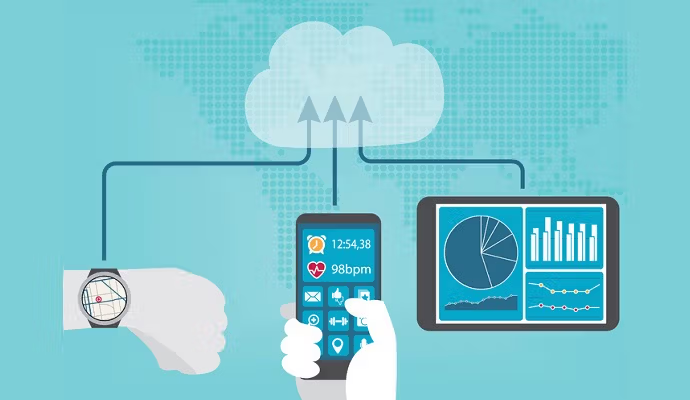
Let’s just be honest about where healthcare is right now. It’s too fragmented. It’s often reactive. We spend too much time chasing paper and too little time actually connecting with patients. Remote Patient Monitoring (RPM) changes that equation entirely. It’s not just tech; it’s the digital infrastructure that allows us to deliver continuous, compassionate care.


Think about the millions of people living with chronic conditions, diabetes and cardiac issues; they need a guardian, not just an appointment slot. RPM provides that virtual presence.
In this blog, we will discuss what your RPM system absolutely must do, what the real investment looks like, and how to make sure you’re riding the right market waves. Crucially, we’ll talk about why finding the right software development partner is the only way to succeed.
What Makes an RPM Solution Worth Investing In?
If you’re going to spend the time and money, the platform has to be more than a data dump. It has to solve real problems for your clinical staff and your patients. To create an effective RPM solution, healthcare software development services are essential. This ensures that the technology complies with both medical requirements and regulatory standards.
1. Data Flow Must Be Effortless
The minute a patient’s blood pressure is taken, that number needs to appear where the doctor can see it. No syncing hassles. No manual logs. A great system pulls data from every device, wearables, monitors, sensors, and harmonizes it. It removes friction. If your staff has to fight the software just to get the numbers, the whole project fails.
2. The System Has to Be Clinically Smart
The biggest anxiety for a doctor is missing something critical. Your RPM solution needs to act as an intelligent filter. It shouldn’t just display data; it should be programmed to detect when a patient enters a danger zone and trigger a precise alert. This exception-based vigilance helps catch subtle declines before they lead to preventable ER visits, driving significant cost savings.
3. Empowering the Patient, Making Health Management Easy
If the patient software is clunky, users quit. Tools must be designed to be intuitive, encouraging, and helpful. When patients can check their phones to monitor progress, receive simple advice, and feel like active participants, they are more likely to remain compliant. The shift is from telling people what to do to partnering with them.
4. Translating Data into Clinical Insight
With the overwhelming amount of data available, the need for insight becomes critical. The analytics component must be able to identify subtle, underlying trends, such as when a small medication adjustment is needed. This approach moves from merely treating symptoms to making predictive, evidence-based decisions, enhancing clinicians’ speed and effectiveness.
5. Trust Is Non-Negotiable
In healthcare, the sensitivity of the information is unparalleled. Security is paramount. The RPM platform must be engineered with uncompromising compliance with HIPAA and GDPR, integrated deeply into its foundation, not as an afterthought. If patients do not trust the system’s security, the entire effort will fail.
6. Seamlessly Fitting into Your Existing Practice
A successful RPM platform is not just another tool; it is an extension of the current care process. It must integrate seamlessly with the existing EHR, providing the necessary data context to make virtual visits meaningful. It completes the digital care continuum.
Let’s Talk Investment: The Real Cost of Excellence
Building enterprise-grade RPM software isn’t like buying new office furniture; it’s a strategic infrastructure play. The cost isn’t fixed, but it is predictable if you understand the drivers:
- Complexity drives the biggest swing: A simple dashboard with basic vitals tracking stays reasonably priced. Throw in AI-powered risk scoring, predictive alerts, or custom clinical pathways, and you’re paying for serious expertise; that’s where the cost climbs.
- EHR integration is usually the heaviest lift: Integrating with Electronic Health Records is often the most complex task. It requires significant time, resources, and expertise, so this is a major cost driver.
- Custom vs. off-the-shelf changes everything: Off-the-shelf forces your clinicians to work the way the software wants them to. Custom costs more upfront, but when the workflows match how your teams already operate, adoption is night-and-day better.
- It’s never truly “one and done.” Security patches, compliance updates, new device support, and feature expansions- budget them for every year.
In short, building a custom RPM platform usually costs between $40,000 and $400,000, depending on features and complexity. While it’s a significant investment, the long-term benefits in patient care and operational efficiency make it worthwhile.
Where We’re Headed: Key Trends to Watch
The market is moving at lightning speed. Your system needs to be future-proofed against these shifts:
- The Rise of High-Acuity Use: RPM has moved beyond step counters and blood-pressure checks. It’s now the frontline tool for managing seriously ill patients, cardiac issues, COPD, and post-surgical cases, right from home. The real goal: catch problems early, cut readmissions, and keep people out of hospital beds.
- AI’s Predictive Jump: AI is moving from understanding what has already happened to predicting what’s about to happen. Soon, AI will serve as a co-pilot for clinicians, alerting them to potential risks hours or even days before the patient notices any symptoms. This shift allows for more proactive care and better patient outcomes.
- Policy Support is Growing: Medicare and major insurers now see the hard savings RPM delivers. New codes, higher rates, and clearer guidelines are rolling out quickly, turning “nice-to-have” projects into obvious financial wins.
- Patient-Centered Design: For RPM to work, the design must be simple for everyone to use. Seriously, if a 70-year-old can’t use the app, it’s a waste of time. People need tools that feel invisible and intuitive, letting patients manage their health confidently. The rule is: meet them where they are.
Why Partnership is Essential
You are the experts in medicine. Your staff are experts in clinical workflow. You shouldn’t have to become experts in regulatory code and cloud hosting.
Building complex, compliant RPM software requires a specialized skill set. That’s why the smartest organizations look for a strategic software development partner, someone who understands the clinical world and the technical world simultaneously. They know the regulatory maze, the complexity of EHR integration, and the pressure of delivering a reliable product.
By partnering with an experienced team, you significantly reduce project risk. You focus on providing exceptional care, and they handle the development, ensuring the digital foundation is rock-solid, scalable, and secure.
Software development services will be essential to developing systems tailored to the needs of the medical sector. A skilled development team that knows the ins and outs of healthcare software can help you create a platform that not only functions but also succeeds in a highly sophisticated, highly regulated setting. Your medical center should be equipped with the most suitable resources to provide care, and when you leave the contract with the appropriate software development services, you can be sure that this is what you will receive.
The Final Word
RPM is the bedrock for delivering high-quality, continuous, empathetic care in the digital age. Get the feature set right, approach the cost as a necessary investment, and most importantly, find a great development partner. This isn’t just about software; it’s about securing the future of patient care.









