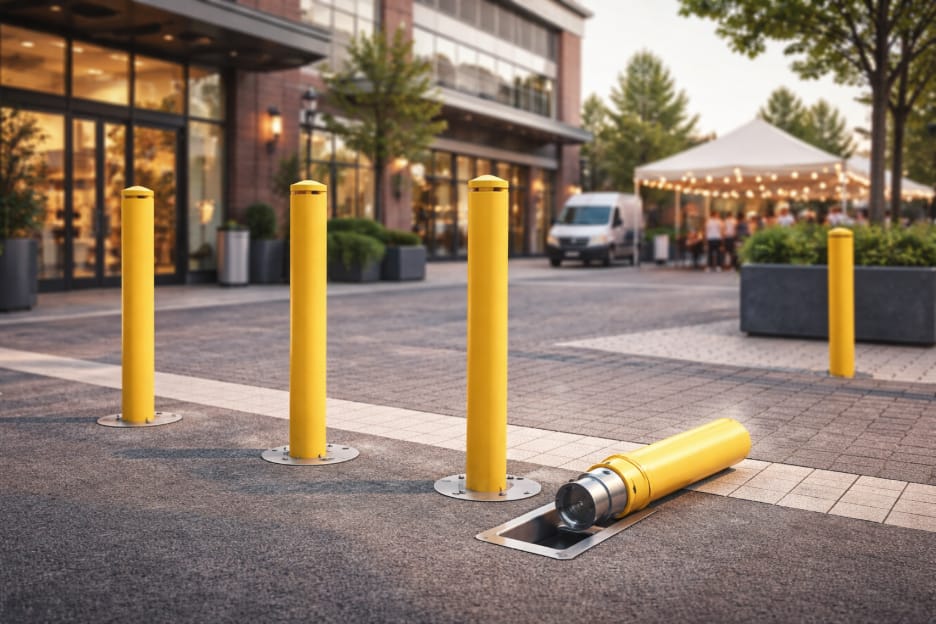
Controlling access to your space can be more complicated than you thought. You must safeguard individuals and property against automobile hazards, but on the other hand, you cannot close critical access points. The deliveries should not be stopped, emergency vehicles should be allowed to pass, and events should have flexible layouts.


Nonetheless, barriers do not allow movement, and low-quality choices cannot resist pressure. Consequently, installing the wrong bollard will either disturb the functioning or expose your area to damage. Consequently, it is essential to understand safety, flexibility, and long-term usability to make the correct decision.
This article provides information on the process of selecting the appropriate removable bollard for your business or event.
1. Start with Purpose, Not the Product
You should consider the reasons why you need a bollard before comparing materials or specifications. This ensures that all further decisions are relevant & practical.
A removable bollard offers the flexibility you require if you want to control access temporarily, such as during business hours or events. It enables you to close an area when you need it and open it when you need to access it. The purpose, however, is not limited to access control.
In most instances, the protection against vehicle impact is also required by the business. To illustrate, storefronts, footways, and car parks are prone to accidental or premeditated collisions. Thus, your bollard should act as an access management device as well as a security barrier.
Moreover, the frequency of removal of the bollard should be considered. Constant usage requires a system that can be easily handled and yet retain strength. Having a clear purpose will help you not to choose a solution that will complicate operations or fail in crucial situations.
2. Focus on Real Safety Performance

Once you have a clear purpose, the next step is to evaluate the level of protection the bollard offers. This is where many decisions go wrong.
It is tempting to believe that every bollard provides the same defense. A big distinction, however, exists between decorative posts and crash-rated systems. Using simple designs can have severe consequences, especially when your place is exposed to vehicles.
Rather, consult established safety standards, such as ASTM testing standards. These ratings determine whether a bollard will prevent a moving vehicle and how far the vehicle will go after impact.
As an example, a high-performance bollard is able to stop a standard vehicle at a relatively moderate speed with limited penetration. This degree of protection is necessary in those places where pedestrians and vehicles are in close contact.
Meanwhile, the significance of consistency should not be disregarded. The removable design must not undermine strength. The most desirable solutions have the same protection, whether installed permanently or in a removable form.
3. Choose Efficiency in Installation and Use
Once safety is addressed, think about how the bollard will fit into your workflow. Both cost and convenience are directly influenced by the installation and daily usage.
The traditional systems often require complex procedures like excavation, reinforcement, and welding. Consequently, they increase labor time and disrupt normal operations. For businesses and event organizers, this can create unnecessary delays.
In comparison, the modern installation techniques make it a lot easier. Quick setup systems minimize downtime and can be deployed more quickly. This is especially useful when there are strict deadlines or when several bollards have to be placed in one place.
In addition to installation, consider everyday use. A removable bollard must be user-friendly without incurring high effort or the use of specialized equipment. Meanwhile, it should be secure enough to avoid unauthorized removal.
4. Adapt to Your Space, Not the Other Way Around

Each site has unique layout challenges. Hence, your bollard system must fit your surroundings rather than demand inflexible positions.
Begin with the analysis of physical space. The placement of the bollards is affected by entry points, traffic flow, and surface conditions. For example, uneven grounds or gradually declining surfaces demand solutions that do not involve complex modification.
In addition, flexibility in spacing is important. Fixed spacing may introduce gaps in protection or limit movement unnecessarily. An effective system will enable you to place the bollards depending on your requirements.
Impact direction is the other significant aspect. In practical situations, cars will hardly move in one direction. Therefore, the overall safety is enhanced by selecting a bollard, which has the capacity to counter multi-directional impact.
5. Balance Access with Control
Security alone is not effective if it disrupts daily operations. At the same time, unrestricted access defeats the purpose of installing bollards. Therefore, achieving the right balance is essential.
Consider how often access points need to be opened. Staff, service vehicles, and emergency responders all rely on smooth entry and exit. A poorly designed system can slow down these processes, leading to inefficiencies.
For this reason, the removal mechanism should be straightforward yet secure. It must allow authorized users to operate it easily while preventing misuse. Additionally, durability is crucial, especially in high-traffic areas where the bollard will be handled frequently.
Storage is another overlooked aspect. When the bollard is removed, it should be easy to store without causing clutter or damage. Organized storage ensures that the system remains functional and ready for reuse.
Conclusion
Choosing the right removable bollard involves more than selecting a physical barrier. It requires a thoughtful approach that considers safety, flexibility, usability, and long-term performance.
When you begin with a clear purpose, prioritize real protection, and choose solutions that fit your environment, you create a system that works seamlessly. At the same time, balancing accessibility with control ensures that daily operations remain smooth.
Ultimately, the right choice allows you to protect your space without limiting how it functions—giving you both security and flexibility when it matters most.