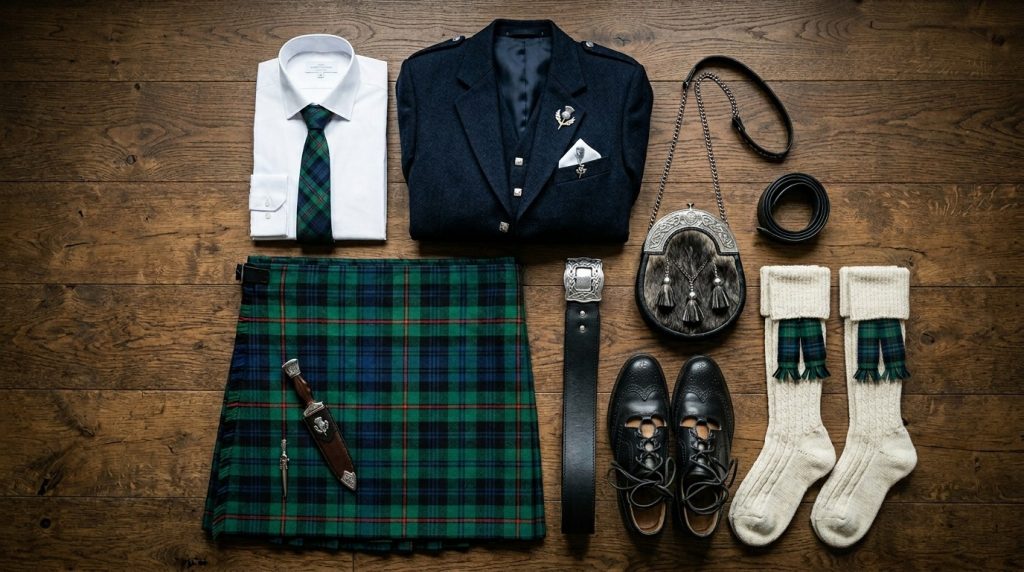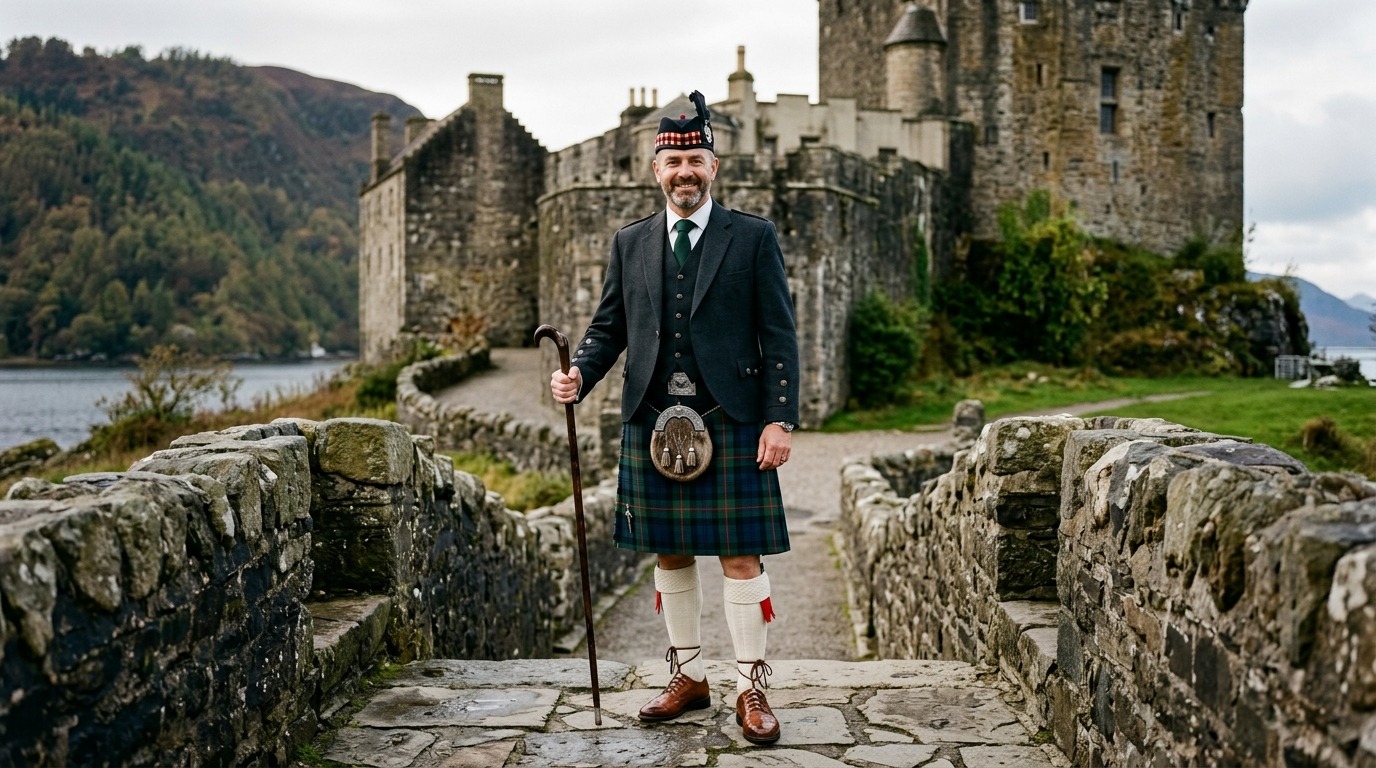
A Scottish kilt outfit isn’t a kilt with a few accessories thrown on. It’s a complete system — nine specific pieces working together — and getting any of them wrong is the difference between looking like a Highland gentleman and looking like a guy who rented a costume two hours before the wedding.
I’ve watched dozens of friends, groomsmen, and first-time wearers stress about the kilt itself and then panic at the last minute over everything else. The kilt is actually the easy part. The supporting cast is where most outfits fall apart.
So here’s the complete checklist — nine pieces, in the order they actually matter, with the one piece almost everyone underestimates ranked at
1: Ghillie Brogues — The Piece Everything Else Hangs On


If you take nothing else from this article, take this: your shoes will make or break the entire kilt outfit.
Ghillie brogues are the traditional Scottish kilt shoe — and they’re not just any black dress shoe with laces. The defining features are:
– **No tongue.** The shoe is open-laced, exposing the top of your foot
– **Long laces** that wrap around the ankle and tie below the calf
– **Punched leather pattern** (the “broguing”) across the toe and sides
– **Polished black leather** is standard for formal wear
– **Thin, flat sole** that sits low to the ground
These design choices aren’t decorative. The open lacing was originally so the shoes wouldn’t get waterlogged crossing Highland streams. The wrap-around lacing kept them on while running across rough ground. The fact that they look incredible with a kilt is essentially a happy historical accident.
Wear regular dress shoes with a kilt and you’ll look off — even if everything else is perfect. The proportions are wrong, the styling clashes, and any Scot in the room will spot it immediately.
A solid pair of Ghillie brogues runs $80 to $200 depending on leather quality and construction. Buy a good pair once. They’ll outlast three kilts.
2: The Kilt Itself
Now we get to the obvious one — but with a few non-obvious points.
For a traditional Scottish kilt outfit, you want:
– **Tartan wool**, not solid color (saffron kilts are Irish, not Scottish)
– **8-yard construction** for formal events; 5-yard for less formal occasions
– **Knife pleats at the back**, with the pleated pattern matching the front apron’s tartan
– **Length to the middle of the kneecap** — not above, not below
– **Proper waist sizing** at your natural waist (above the navel), not your jeans waist
The tartan you choose matters too. If you have a clan affiliation, that’s the obvious pick. If not, “universal” tartans like Black Watch, Royal Stewart, or Pride of Scotland are widely accepted. Avoid novelty tartans for formal events.
3: The Sporran
The sporran is the leather pouch worn at the front of the kilt. Kilts famously don’t have pockets, so the sporran isn’t optional — it’s functional.
Three main types:
**Day sporran** — Plain brown or black leather, simple buckle closure. For casual or daytime events.
**Semi-dress sporran** — Black leather with chrome or silver hardware. Works for most weddings and formal events.
**Full dress sporran** — Sealskin or horsehair, often with a heavy ornamental cantle (top piece). For black-tie events, formal balls, and military ceremonies.
The sporran sits at the front-center of the kilt, hanging from a chain that loops behind. It should rest just below the kilt’s waistband, not lower.
4: Kilt Hose (The Socks)
Kilt hose are knee-high wool socks. They’re not optional, and they’re not the same as ordinary long socks.
Standard rules:
– **Cream, off-white, or charcoal grey** for most events
– **Pure white** only for military or pipe band uniforms
– **Hose tops folded down** about 4 inches below the knee
– **Garter flashes** (more on these next) hold them up
Cheap synthetic kilt hose look exactly like cheap synthetic kilt hose. Wool or wool-blend is worth the $25 to $40 difference.
5: Garter Flashes
Garter flashes are the small ribbons that peek out from the folded top of your kilt hose. They serve two purposes: they hold up the elastic garter that keeps your hose from sliding down, and they add a punch of color to the outfit.
Traditional rules:
– Flashes should match either your tartan or your tie
– Red is the most common universal color
– They should peek out about 1 to 2 inches below the folded hose top
– Both legs should match exactly
This is one of those small details where the difference between “good outfit” and “great outfit” lives.
6: The Shirt
For most Scottish kilt outfits, you want:
– **White or cream long-sleeved shirt** with a banded or wing collar
– **French cuffs** for formal events (cufflinks let you add personality)
– **Ghillie shirt** (loose, lace-up Jacobite style) for less formal or themed events
The standard wedding/formal pairing is a white wing-collar shirt with a black bow tie. The ghillie shirt with no tie works for casual highland games, ceilidhs, and outdoor heritage events.
7: The Jacket and Waistcoat
Three jacket options cover almost every situation:
**Argyll jacket** — The most versatile. Black or charcoal wool with silver buttons. Worn with a matching waistcoat for formal events, or alone for semi-formal. Works for weddings, Burns Night, and most evening occasions.
**Prince Charlie jacket** — More formal than the Argyll. Black wool with tail-style cut and silver buttons. Worn with a matching three-button waistcoat. This is your black-tie-equivalent kilt jacket.
**Tweed jacket** — Casual and country-style. Earth-toned tweed in brown, green, or grey. For daytime events, country weddings, and outdoor occasions.
Match your jacket choice to the formality of the event. Don’t wear a Prince Charlie to a casual ceilidh, and don’t wear tweed to a formal black-tie wedding.
8: The Belt and Buckle
A black or brown leather kilt belt with a polished metal buckle sits over the kilt waistband. Two important rules:
– The belt should be wide — typically 2.25 inches — not a regular trouser belt
– The buckle should match the metal tones in your sporran chain, jacket buttons, and sgian dubh
A common mistake: wearing a thin dress belt with a kilt. It looks instantly wrong. The kilt belt is a substantial piece that frames the waist of the kilt itself.
9: The Sgian Dubh
The sgian dubh (“skee-an doo”) is the small ceremonial knife traditionally tucked into the top of the right kilt hose, with only the handle visible above the sock.
Modern rules:
– Required for fully traditional dress, optional otherwise
– Handle should be visible; blade fully sheathed
– Must follow local laws (some venues, airports, and events restrict them)
– Match the handle material and metalwork to the rest of your outfit
If you’re wearing it to a wedding or formal event, check with the venue first. Some modern venues have weapons policies that include ceremonial blades.