


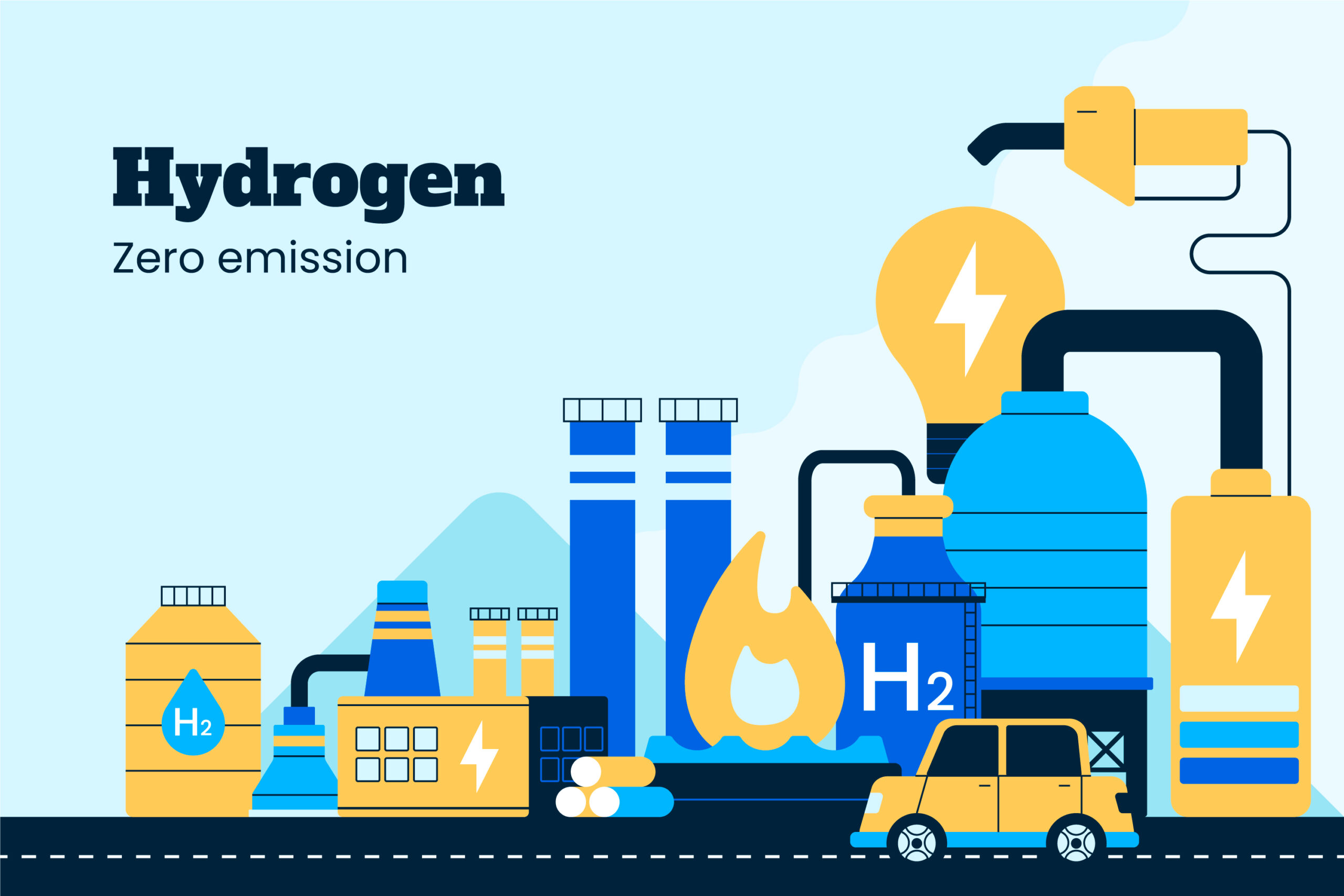
The production of hydrogen has become one of the most talked-about topics in today’s energy landscape. With the global shift toward cleaner fuels and reduced carbon emissions, hydrogen is a versatile carrier that has the potential to reshape how we power industries, transport, and even homes.


Why hydrogen matters
By mass, hydrogen holds almost three times more energy than gasoline, making it incredibly powerful for applications where weight is critical, like aviation or long-haul trucking. When consumed in a fuel cell, it releases only water vapor, positioning it as a zero-emission alternative to fossil fuels.
However, the production of hydrogen is not straightforward. Building the right infrastructure is costly, and different production methods have different impacts on the environment. That’s why choosing how to produce it is so important.
Grey and blue hydrogen
Currently, most hydrogen used in industry comes from natural gas through processes like steam methane reforming (SMR) or autothermal reforming (ATR). This is called grey hydrogen. The process is efficient but releases significant amounts of CO₂ into the atmosphere.
If carbon capture and storage (CCS) technologies are applied to trap those emissions, the product becomes blue hydrogen. While cleaner than grey, the environmental benefits depend heavily on how effectively the captured carbon is stored. Blue hydrogen is often seen as a transitional option – better than fossil fuels, but not as clean as renewable-powered solutions.
Turquoise hydrogen
A newer method for the production of hydrogen is methane pyrolysis, which generates what’s known as turquoise hydrogen. In this case, instead of producing gaseous CO₂, the process breaks methane into hydrogen gas and solid carbon. Handling carbon in solid form is far simpler and more cost-effective than capturing and storing it as a gas.
This method is still new, but it looks very promising, especially if the high heat for pyrolysis comes from renewable energy.
Green hydrogen
Often described as the “gold standard,” green hydrogen is made through electrolysis – splitting water into hydrogen and oxygen – using electricity from renewable sources like wind, solar, or hydro. The result is completely carbon-free hydrogen.
Green hydrogen also offers unique advantages as an energy storage solution. Extra renewable energy that might otherwise be wasted can be stored as hydrogen and later turned back into power when needed, without losing strength over time like batteries do.
The challenge, however, is cost and efficiency. Electrolyzers are still expensive, and current systems operate at about 70-80% efficiency. Scaling up production and improving technology will be key to making green hydrogen competitive.
Less common methods
Besides these main types, researchers are also testing several experimental methods. Nuclear-assisted hydrogen production, or “pink hydrogen,” uses nuclear power as the energy source. Photocatalytic water splitting mimics photosynthesis, using sunlight and special materials to separate water molecules directly. Biological methods, using algae or bacteria, are also being explored. Although these pathways are far from widespread, they represent exciting possibilities for diversifying the production of hydrogen in the future.
What else should you know?
While hydrogen has enormous potential, there are a few limitations. Compared to fossil fuels, its cost per unit of power remains high. Storage and transport add complexity, as hydrogen is the smallest molecule on the periodic table and prone to leakage. Safety measures must be stringent, given its flammability.
Governmental policies and incentives are playing a crucial role in offsetting these challenges, helping accelerate investment and adoption. Still, a coordinated approach that balances environmental responsibility, cost, and technical feasibility will be simply necessary.
The takeaway
The production of hydrogen definitely isn’t a one-size-fits-all solution. For hydrogen to really drive the clean energy shift, one method alone won’t be enough. It’ll probably take a mix of technologies, strong policies, and ongoing innovation to decide how quickly it can replace fossil fuels.









