


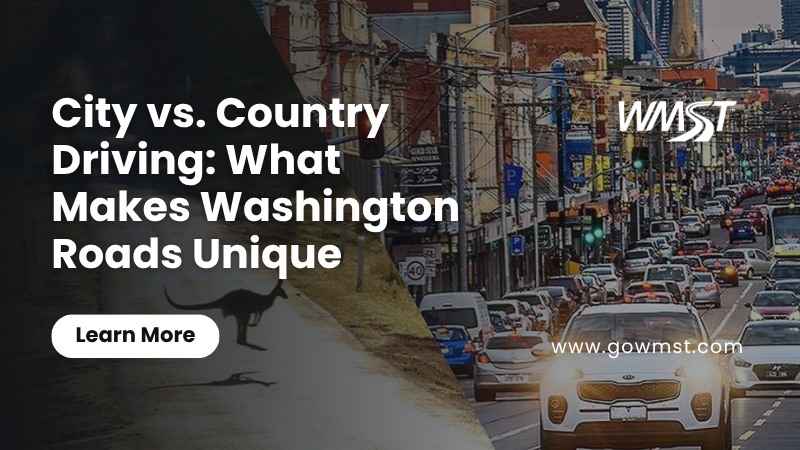
From the dense, fast-paced traffic of the I-5 corridor in Seattle to the winding, two-lane rural roads of the Palouse, Washington driving environments are a study in contrasts. A driver who is only comfortable in one will be unprepared and unsafe in the other.


Understanding the unique skills, hazards, and mindset required for both rural vs. urban driving is the key to being a truly confident and defensive driver in the Evergreen State.
Understanding the Differences Between City and Rural Roads
The core challenge of urban driving is overload; the challenge of rural driving is unpredictability.
- Urban & City Driving (Seattle, Bellevue, Tacoma): This environment is about managing a high volume of predictable hazards. You are surrounded by pedestrians, cyclists, buses, and other cars in tight spaces. The risk is a low-speed collision caused by a moment of distraction.
- Rural & Country Driving (Eastern WA, Mountain Passes): This environment is about managing unpredictable hazards. You may be the only car on the road, but you face blind corners, wildlife, slow-moving farm equipment, and a higher risk of a high-speed, serious accident.
Key Challenges in Seattle’s Urban Traffic
Driving in downtown Seattle requires a specific set of skills. The environment is crowded, complex, and demands 100% of your focus.
- High-Density Hazards: You must constantly scan for pedestrians (who may not be at a crosswalk), cyclists in bike lanes, and buses pulling back into traffic.
- Complex Intersections: Navigating one-way streets, “No Turn on Red” signs, and lanes that are for buses only requires you to read and process multiple signs at once.
- Steep Hills: Seattle’s hills are a real test. You must master hill parking (turning your wheels to the curb) and learn to stop and start on a steep incline without rolling back.
- Heavy Congestion: Seattle traffic tips always start with patience. Stop-and-go traffic on I-5 or I-405 is a test of your focus and your ability to maintain a safe following distance.
Safety Tips for Narrow or Curvy Rural Roads
It’s easy to get complacent on a quiet country road, but statistics show rural roads have a much higher fatality rate than urban highways.
- Handle Blind Corners: On a narrow, curvy road, always assume there is a car, tractor, or deer just around the bend. Slow down before the curve, not during it, and keep your vehicle firmly in your lane.
- Aggressively search the road ahead: Look as far through the corner as you can see and search for clues, such as the tree line, guardrail or movement of cars for clues as to what is up ahead.
- Watch for Wildlife: Especially at dawn and dusk, be vigilant for deer, elk, and other animals. If you see one, slow down and assume more are following.
- Expect Slow-Moving Vehicles: You may come up quickly on a tractor, combine, or logging truck. Be patient. Do not tailgate, and only pass in a legal, clearly marked passing zone when you have a long, clear view of oncoming traffic.
- The 4-Second Rule: On rural highways, the speeds are higher. We teach the 4-second following distance to give you the time you need to react to a sudden animal crossing or a vehicle stopping.
- Expect the unexpected: The combination of closed sight lines and higher speeds creates opportunities for driving into an unseen hazard. Anytime your vision is blocked, whether by trees, fields of grain or a slight knoll, slow down and expect something to emerge just past where you can see.
How WMST Prepares Drivers for Every Environment?
At WMST, we know our job isn’t just to teach you to pass the Skills Test; it’s to teach you how to be a safe driver for life, in all of Washington’s environments.
Our curriculum is designed to build these adaptive skills:
- For Urban Driving: Our six full hours of real behind-the-wheel instruction (not simulations) put you in complex traffic situations with an instructor. We drill the core skills of highway vs. local road safety, smooth braking for stop-and-go traffic, and the 360-degree awareness needed for busy intersections.
- For Rural Driving: While the test itself is in town, our training gives you the foundational skills you need. We master low-speed control for sharp turns, teach the 4-second following distance for high-speed safety, and build the defensive mindset that helps you anticipate hazards like blind corners and wildlife.
We build drivers who can confidently manage the chaos of a Seattle rush hour and the high-speed unpredictability of a rural highway.
Frequently Asked Questions (FAQs)
Is driving in Seattle harder than in small towns?
It’s not “harder,” but it is more complex. Seattle requires constant, high-level focus to manage pedestrians, cyclists, hills, and dense, multi-lane traffic. Rural driving is less complex but can be more dangerous if you’re not prepared for high speeds, blind corners, and sudden wildlife.
How do I handle blind corners in rural areas?
Slow down before you enter the corner. Stay in the middle of your lane Assume there is an oncoming car or hazard, such as a driveway or mailbox, that you can’t see, and be prepared to adjust.
Are rural roads included in the driving test?
No. The Washington DOL Skills Test is not a “rural road test.” It takes place on public residential streets and main arterial roads. It does not include high-speed freeway or remote rural road driving. It is designed to test your mastery of specific maneuvers (backing, parallel parking, hill parking) and your ability to safely navigate common traffic, intersections, and lane changes.
How do I plan routes with less traffic?
Before you leave, use a real-time GPS app like Google Maps or Waze. They analyze current traffic data to find the fastest route, which is often not the shortest. For commuting, learning the local side streets can help you bypass major “choke points.”
Does WMST offer both city and rural lessons?
Our state-approved testing routes are on urban and residential streets, as required by the DOL. Our WMST driving education focuses on building the universal, fundamental skills (like speed control, scanning, and the 4-second rule) that you will apply to all Washington driving environments, from the city to the country.









