


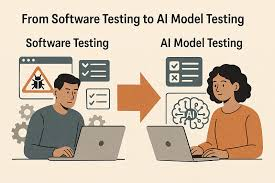
It was a typical Tuesday morning in Sarasota, Florida. Michael, a senior QA manager with more than a decade of experience, sat at his kitchen table reviewing overnight test results before heading into the office.


The software release had gone smoothly, or so everyone thought.
Then came the alerts.
Several automated tests had failed overnight. At first glance, it looked serious. The development team worried that a recent update had broken critical functionality. Michael dug deeper and discovered something frustratingly familiar. The application was working perfectly. The tests themselves had broken because a few user interface elements had been renamed.
Hours would now be spent updating test scripts instead of improving software quality.
As Michael worked through the issue, he reflected on how dramatically software testing had evolved. The traditional testing methods he learned early in his career still played an important role, but artificial intelligence was beginning to transform the way teams approached quality assurance.
This shift is affecting businesses far beyond the technology sector. Whether a customer is ordering products online, scheduling healthcare appointments, or booking an appliance repair visit with a local company, reliable software directly impacts the customer experience.
That reality has fueled growing interest in AI testing and raised an important question: How does AI testing compare to traditional software testing, and what is actually changing?
What Is Traditional Software Testing?
Traditional software testing relies on predefined test cases created and maintained by human testers. These tests are designed to verify that software behaves as expected under specific conditions.
In most organizations, traditional testing includes:
- Manual testing performed by QA professionals
- Automated testing using scripted frameworks
- Regression testing to verify existing functionality
- Functional testing against business requirements
The process has proven effective for many years. It allows teams to systematically validate software and identify defects before they reach customers.
However, software has become increasingly complex. Modern applications update frequently, often multiple times per week or even multiple times per day.
This pace creates challenges for traditional testing approaches.
Advantages of Traditional Testing
Traditional testing offers several important benefits:
- High accuracy when validating known requirements
- Strong human oversight
- Detailed test documentation
- Effective exploratory testing
- Clear visibility into business workflows
Human testers remain particularly valuable when evaluating user experience, design decisions, and unexpected behaviors.
Challenges of Traditional Testing
Despite its strengths, traditional testing has limitations.
Teams often struggle with:
- High maintenance costs
- Fragile automated scripts
- Slow test creation
- Resource-intensive execution
- Difficulty scaling across large applications
When software changes frequently, test maintenance can consume significant time and resources.
Michael’s experience is common. Many QA teams spend substantial effort fixing test scripts rather than uncovering new issues.
What Is AI Testing?
AI testing uses artificial intelligence and machine learning technologies to improve software testing processes.
Rather than relying exclusively on rigid scripts, AI-powered testing platforms can analyze application behavior, adapt to changes, and automate many repetitive testing tasks.
One of the leading examples is testRigor, an AI-based testing platform that allows teams to create tests using plain English instructions rather than traditional programming languages.
This approach helps reduce maintenance while making test automation accessible to both technical and non-technical users.
How AI Testing Works
AI testing platforms typically leverage:
- Machine learning
- Natural language processing
- Intelligent test generation
- Self-healing automation
- Risk-based test prioritization
Instead of identifying user interface elements solely through fragile technical selectors, AI systems often recognize context, behavior, and relationships between elements.
As applications evolve, AI-powered tests can adapt more effectively than traditional scripts.
AI Testing vs Traditional Software Testing: Key Differences
The fundamental difference lies in adaptability.
Traditional testing follows predefined instructions exactly as written.
AI testing learns patterns, identifies changes, and adjusts automatically in many situations.
| Category | Traditional Testing | AI Testing |
| Test Creation | Often requires coding | Can use natural language |
| Maintenance | High effort | Reduced maintenance |
| Adaptability | Limited | Highly adaptive |
| Scalability | More difficult | Easier to scale |
| Execution Efficiency | Manual optimization | Intelligent prioritization |
| Learning Capability | None | Continuously improves |
This does not mean AI testing replaces traditional testing entirely.
Instead, many organizations use both approaches together to achieve better results.
Why Reliable Software Matters for Every Business
Software reliability is no longer just a concern for technology companies.
Nearly every business depends on software to serve customers.
A local appliance repair company may rely on:
- Online scheduling systems
- Customer management software
- Payment processing platforms
- Mobile applications
- Automated communications
Imagine a homeowner dealing with a broken refrigerator during a summer heatwave.
They visit a repair company’s website hoping to schedule service quickly.
If the booking system crashes, displays errors, or fails to submit requests properly, that customer may leave and contact a competitor instead.
For appliance repair businesses like D.R. Express Service Appliance Repair, reliable software contributes directly to customer satisfaction and revenue.
Better testing helps prevent these situations from occurring.
Data Shows Why Modern Testing Matters
The push toward AI-powered testing is supported by industry research.
According to IBM’s 2024 Cost of a Data Breach Report, the average cost of a data breach reached $4.88 million globally, the highest amount ever recorded.
This highlights the importance of identifying software vulnerabilities and defects early.
The World Quality Report consistently reports growing investment in test automation and quality engineering as organizations seek faster releases and better customer experiences.
Additionally, GitLab’s Global DevSecOps Survey found that organizations increasingly prioritize automation to accelerate software delivery while maintaining quality and security standards.
These trends demonstrate that software quality has become a strategic business priority.
Expert Perspective on the Future of Testing
Industry experts increasingly view AI as a tool that enhances human testers rather than replacing them.
Jason Arbon, former Google engineering leader and software testing expert, summarized this perspective well:
“The future of testing is not about replacing testers. It’s about amplifying human capability.”
This statement reflects what many organizations are experiencing today.
AI handles repetitive and time-consuming activities while testers focus on critical thinking, exploratory testing, and business strategy.
Key Insights for Businesses
Several important lessons are emerging from the rise of AI testing.
- Software quality directly impacts customer trust.
- Testing maintenance costs can grow significantly over time.
- AI can reduce repetitive testing work.
- Human expertise remains essential.
- Faster testing often leads to faster innovation.
Organizations that balance automation with human oversight typically achieve the best outcomes.
Practical Steps for Adopting Modern Testing
Businesses considering AI testing can start gradually.
Practical steps include:
- Evaluate AI-powered platforms such as testRigor.
- Identify repetitive testing tasks suitable for automation.
- Focus first on high-risk customer-facing workflows.
- Measure maintenance time before and after implementation.
- Train teams on AI-assisted testing practices.
Successful adoption usually happens through incremental improvements rather than a complete transformation overnight.
Limitations of AI Testing
Despite its benefits, AI testing is not a perfect solution.
Organizations should understand potential limitations.
- Initial implementation requires planning.
- AI systems still require human oversight.
- Some complex business scenarios need manual validation.
- Learning curves may exist for new teams.
- Results depend on proper configuration and usage.
The most effective testing strategies combine AI capabilities with experienced human judgment.
Conclusion
Later that afternoon, Michael finally finished reviewing the release.
Years earlier, he might have spent days repairing broken automation scripts. Today, AI-assisted testing tools helped his team focus on real software risks instead of routine maintenance.
That experience reflects a broader change happening across the software industry.
Traditional testing remains valuable and necessary. Yet AI is helping teams test faster, scale more efficiently, and spend less time maintaining fragile scripts.
For businesses large and small, from global enterprises to local service providers like D.R. Express Service Appliance Repair, reliable software has become essential to earning customer trust.
The technology behind software testing may continue to evolve, but the goal remains the same: creating experiences that simply work when people need them most.
And perhaps that is the real measure of progress. Not how advanced the testing tools become, but how invisible great software feels to the people who depend on it every day.









