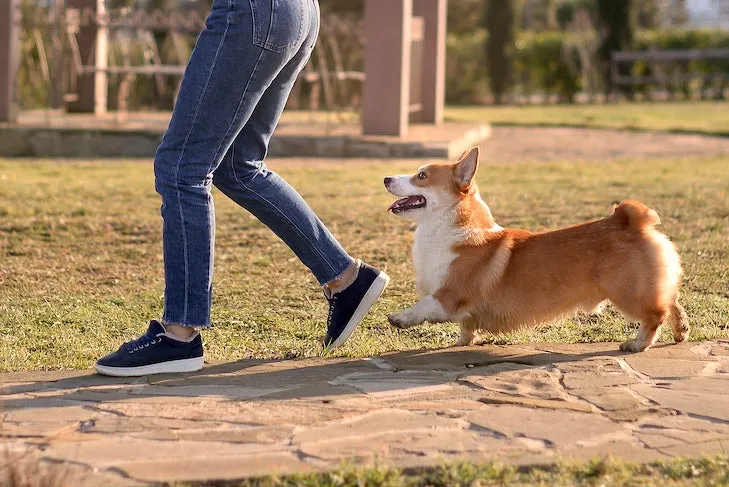
You stand up from the couch, and your dog’s ears perk up. You walk to the kitchen to grab a glass of water, and you hear the familiar click-click-click of paws on the floor behind you. You head to the bathroom, and suddenly, you have an audience. If this sounds familiar, you are the proud owner of a “Velcro dog.”


It is a behavior that ranges from endearing to slightly overwhelming. While it is nice to feel loved, having a shadow that follows you from room to room can make you wonder: Why are you doing this?
The answer lies in a mix of evolution, psychology, and the unique bond you share with your pet. Understanding the root cause is the first step in understanding dog behavior and determining if your dog’s clinginess is healthy affection or a sign of underlying anxiety.
The Evolutionary Roots: It’s a Pack Thing
To understand why your dog acts like your second shadow, you have to look back at their ancestors. Dogs are descendants of wolves, and they are inherently pack animals. In the wild, survival depends on the group. Being alone makes a wolf vulnerable to predators and starvation. Therefore, staying close to the pack leaders and family members is a deeply ingrained survival instinct.
Even though your domesticated pup doesn’t need to hunt for survival or fend off bears, that genetic coding remains. You are their family, their provider, and their safety net. When they follow you, they are essentially maintaining pack cohesion. They want to know where you are going and what you are doing, just in case they are needed—or in case you find something interesting (like food).
The Science of Attachment: The “Love Hormone”
Evolution explains the survival aspect, but biology explains the emotional connection. Studies have shown that when dogs and humans interact, both release oxytocin, often called the “love hormone.” This is the same hormone responsible for bonding between mothers and infants.
Because your presence literally makes your dog feel good chemically, they seek it out. Following you becomes a way to maintain that “feel-good” state. If you often pet, talk to, or look at your dog when they follow you, you are reinforcing this chemical bond. For many dogs, being near you is simply their happy place.
Breed Tendencies: Bred to Work with You
Genetics play a massive role in how independent or clingy a dog is. Humans bred certain dogs to work side-by-side with people for centuries.
- Herding Dogs: Breeds like Border Collies, Australian Shepherds, and Corgis were bred to take direction from a handler constantly. They are naturally inclined to watch your every move because, historically, missing a signal meant losing a sheep.
- Working Dogs: Dobermans and Boxers were often bred for guarding or protection, which requires them to stick close to their charge.
- Toy Breeds: Dogs like Chihuahuas or Shih Tzus were bred primarily for companionship. Their “job” is literally to be a lap warmer, so following you is just them fulfilling their job description.
Conversely, independent breeds like Shibas or certain Terriers might be content napping in another room while you work.
Curiosity and FOMO (Fear Of Missing Out)
Dogs are naturally curious creatures, and their world is relatively small compared to yours. You are the most exciting thing in their environment. When you get up and move, you are making things happen. Are you getting a snack? Are you grabbing the leash? Is there a squirrel in the backyard?
Your dog follows you because they don’t want to miss out on the action. This “Fear Of Missing Out” is often driven by a history of reinforcement. If following you to the kitchen usually results in a piece of cheese dropping on the floor, your dog learns that following you is a profitable activity.
Normal Velcro Behavior vs. Separation Anxiety
While following you is generally normal, there is a fine line between a dog that loves you and a dog that is terrified to be without you. It is crucial to distinguish between a “Velcro dog” and a dog suffering from separation anxiety.
A Healthy Velcro Dog:
- Follows you into a room but settles down quickly.
- Watches you but doesn’t panic if you close a door.
- Can be left alone at home without destroying furniture or barking incessantly.
- Retains their appetite and calm demeanor when you aren’t right next to them.
A Dog with Separation Anxiety:
- Displays visible distress (panting, pacing, whining) as soon as you prepare to leave.
- Cannot settle down if you are in another room behind a closed door.
- Engages in destructive behavior when left alone.
- Follows you frantically, as if glued to your leg, rather than just trotting nearby.
If your dog’s shadowing seems rooted in panic rather than affection, you may need to look for ways to build your dog’s confidence to help them feel secure when they aren’t by your side.
How to Manage a Clingy Dog
If your dog’s shadowing is becoming a tripping hazard or feels excessive, you can take steps to encourage a bit more independence without damaging your bond.
1. Teach the “Place” Command
One of the most effective tools for a Velcro dog is the “Place” or “Mat” command. This trains your dog to go to a specific spot (like a bed or mat) and stay there until released. It teaches them that they can observe you from a distance and still be safe. Start with short durations and high rewards, gradually increasing the time they stay on their mat while you move around the room.
2. Desensitize Your Movements
If your dog jumps up every time you shift in your chair, they are oversensitive to your cues. You can desensitize them by making your movements meaningless. Stand up, then sit back down immediately. Walk to the door, touch the knob, and return to the couch. Do this repeatedly without interacting with your dog. Eventually, they will learn that your movement doesn’t always signal an exciting event, and they might just stay in bed.
3. Provide Mental Stimulation
A bored dog is a clingy dog. If your dog has nothing better to do, following you becomes their primary entertainment. Interactive toys, puzzle feeders, and long-lasting chews can give them something to focus on that isn’t you. When they are engaged in a task, they are learning to be content by themselves.
4. Set Boundaries
It is okay to close the bathroom door. It is okay to have “no-dog zones” in the house. Establishing physical boundaries helps your dog learn that being separated from you for a few minutes is not a crisis. If they whine at the door, wait for a moment of silence before opening it so you don’t reinforce the whining.
Conclusion
Having a dog that follows you everywhere is usually a compliment. It means they view you as their safety, their leader, and their best friend. However, fostering a little independence is healthy for both of you. It ensures your dog is confident enough to relax when you aren’t around and gives you the freedom to make a sandwich without a furry supervisor. By understanding the roots of this behavior, you can appreciate the bond you share while helping your dog become a confident, well-adjusted companion.