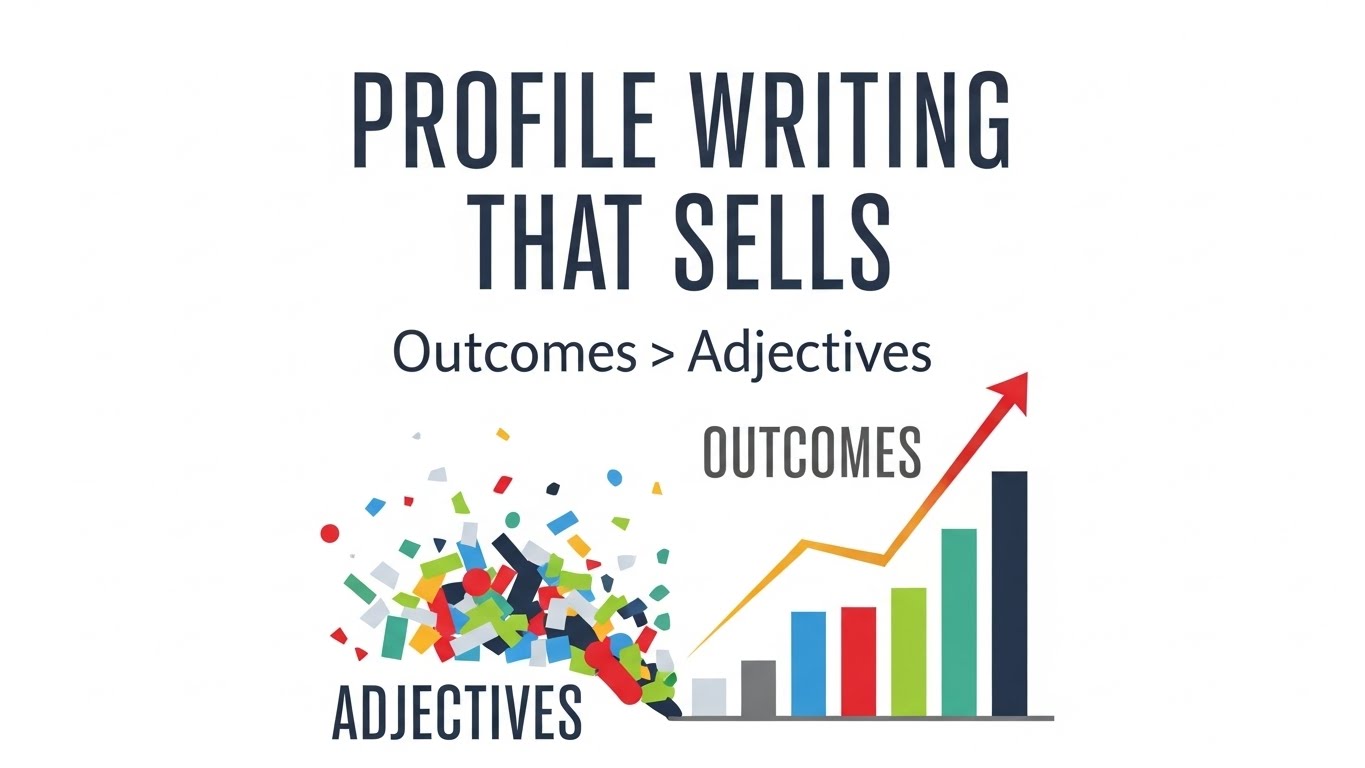
Most freelancer profiles fail for a simple reason. They describe the freelancer instead of the result. Clients do not hire because someone is “experienced,” “reliable,” or “passionate.” They hire because they believe a specific problem will be solved without extra effort on their side.


Profiles that convert replace self-description with clear outcomes. This article explains how to write a profile that sells by focusing on what actually changes for the client.
Why Adjectives Don’t Work
Words like professional, detail-oriented, and results-driven appear in almost every profile. Because everyone uses them, they stop carrying meaning. Clients skim past them without registering value.
Adjectives fail because they:
- Do not show proof
- Do not reduce risk
- Do not explain what will happen after hiring
Outcomes do all three.
Start With the Client’s Situation
Strong profiles open with the client’s problem, not the freelancer’s background. This immediately signals relevance.
Instead of:
I am a Professional web developer with years of experience.
Use:
I help small businesses turn slow, outdated websites into sites that load fast and convert visitors.
The second version makes the client feel understood.
Replace Traits With Results
Every adjective in your profile should trigger a question in your mind: what does this actually lead to?
Examples:
- “Detail-oriented” → fewer errors and less rework
- “Fast communicator” → quicker decisions and fewer delays
- “Strategic thinker” → clearer direction and better priorities
Write the result, not the trait.
Show How Work Gets Done
Outcomes feel more believable when clients understand how you reach them. You do not need to explain every step, but a simple structure builds trust.
For example:
I start by reviewing your existing setup, suggest clear improvements, then deliver updates in stages so nothing feels rushed or unclear.
Process reduces uncertainty.
Use Specific, Everyday Language
Profiles sound artificial when they rely on formal or inflated wording. Clients respond better to simple language that feels natural.
Avoid:
- “Leveraging synergies”
- “Driving impactful solutions”
- “Delivering best-in-class results”
Prefer:
- “Fixing what’s slowing things down”
- “Making things easier to manage”
- “Helping you get results without extra back-and-forth”
Plain language builds credibility.
Focus on One Core Outcome
Trying to cover everything weakens clarity. Strong profiles usually focus on one main result and support it with a few related details.
For example:
I help founders launch clean, clear landing pages that explain their product and get users to sign up.
Additional skills can follow, but the main outcome stays clear.
Let Proof Do the Heavy Lifting
When possible, support outcomes with simple proof:
- Short results from past work
- Client feedback
- Before-and-after descriptions
Even small examples feel stronger than long descriptions.
Platform Context Without Dependence
Some marketplaces reward keyword-heavy profiles, while others reward clarity and structure. Platforms like Osdire are designed around clear services and outcomes, which aligns naturally with outcome-focused profiles. The advantage comes from reducing guesswork for clients, not from platform-specific tactics.
Final Takeaway
Profiles sell when they help clients picture a better situation after the work is done. Adjectives describe intent. Outcomes describe change.
If a client can quickly see what improves, how it improves, and why it matters, the profile has done its job.