Applying for jobs can feel like tossing your résumé into a black hole. You might wonder: How many applications do I really need to send out to land a job? The answer isn’t one-size-fits-all, but recent data and studies paint a clear (and sobering) picture.


In this guide, we’ll break down the numbers behind job applications and, more importantly, show you what you can do to beat the odds. Whether you’re sending your first application or your hundredth, understanding the math can help you work smarter, not just harder.
How Many Job Applications for One Offer? The Statistics
If you feel like you’ve been applying endlessly, you’re not alone. Recent studies from 2024–2025 reveal that an average job seeker often needs to submit dozens or even hundreds of applications to get a single offer.
Here’s what the data shows:
Job Application Success Rates by Scenario
| Scenario | Applications Needed | Success Rate | Details |
| Best Case | ~30 applications | 3-4% | A 2025 analysis by Career.io found the average job seeker applies to 32 jobs and gets about 4 interviews before being hired |
| Typical Case | 100-200 applications | 0.5-1% | Other 2025 data from large job platforms show many job seekers need 100–200+ applications for one offer |
| Competitive Markets | 400+ applications | <0.5% | In highly competitive markets, even 400+ applications might be needed to land one job |
The Reality Check: Each individual job application might have only a 1 in 100 chance (or less) of resulting in a job offer. As one career expert notes: Even at a 2% success rate, you’d need to apply to 50 jobs to statistically land one offer; at 0.1%, you’d need 1,000 applications.
Why such a huge range (30 vs. 300 applications)? Because your mileage will vary. An in-demand software engineer might score a job with a dozen targeted applications, while someone in a saturated field or switching careers could need hundreds. The key is understanding where you fall on this spectrum and adjusting your strategy accordingly.
Job Application to Interview Ratio: The Hiring Funnel
Every job application goes through a gauntlet of filters before it results in an offer. Understanding this funnel helps explain why the numbers are so brutal.
Here’s how the typical job search funnel breaks down in 2025:
Initial Application Drop-Off Rate
Stage 1: Initial Interest
• ~1,000 people view a typical online job posting
• Only 100-200 actually complete an application
• Why the drop-off? Lengthy forms and self-doubt about qualifications
Stage 2: The ATS Filter
• ~75% of applicants get filtered out by Applicant Tracking Systems
• Only ~25 of 100 completed applications reach a human recruiter
• The ATS challenge: Automated keyword screens and formatting requirements
This is where tools like AIApply become critical. Our AI Resume Builder and Resume Scanner ensure your application is ATS-optimized with the right keywords and formatting, dramatically increasing your chances of passing these automated filters.
How Many Applications Lead to an Interview?
Stage 3: Human Review
Out of applications that pass ATS, only 4-6 candidates. Famous Glassdoor research shows: Average corporate job = ~250 applicants → only 5 (2%) interviewed.
Stage 4: Final Selection
Typically 1 person is hired. Sometimes backup candidates get offers, but essentially one opening = one offer.
The Complete Funnel
1,000 views ↓ 100-200 applications submitted ↓ ~25 pass ATS screening ↓ 4-6 get interviews ↓ 1 gets hired
The Bottom Line: If you’re just one of hundreds of online applicants, your odds of getting the job can be around 0.5% or less. No wonder it can take dozens of tries! As career advisors often say, “It’s a numbers game,” but as we’ll see, it’s not just about sheer volume.
What Affects How Many Job Applications You Need?
It turns out “how many applications it takes” isn’t a single magic number. Several key factors dramatically influence whether you’ll need 20 applications or 200 in your search:
◆ Industry Competitiveness
Highly competitive fields like tech, finance, or media attract a deluge of qualified candidates. Tech roles at popular companies can see hundreds of applicants, meaning you may need to apply to far more jobs to find one open slot.
In contrast: Fields with talent shortages (like nursing in certain regions) might let you secure offers with far fewer applications.
Key insight: Always calibrate your expectations to your field. 2025 job market data shows industries like tech have far higher average application counts per hire than others.
◆ Experience Level
Entry-level candidates or career changers usually have to cast a wider net. Without a track record in the field, you’ll likely send more applications to land an interview since you’re competing against those with direct experience.
Experienced professionals with niche skills might get callbacks from a high percentage of applications because they’re a perfect fit for specialized roles. For instance:
① A senior specialist might need only 10-20 well-targeted applications
② A new graduate could need 10× that number
◆ Job Market and Economy
The broader economic climate in 2025 plays a big role:
Hot job market = Better odds per application (companies eager to fill roles)
Downturn or hiring freeze = Few open jobs get swamped with applicants, requiring more applications to hit a winner
◆ Application Method and Quality
How you apply can dramatically change the numbers:
Spray-and-pray approach:Generic resumes to hundreds of postings yields the lowest success rate (~0.1–2% per application)
Strategic methods: Applying via referral or tailoring your application can boost your hit rate per application significantly, reducing how many total apps you need.
This is exactly why we built AIApply to help you maintain quality at scale, ensuring each application is customized without the manual effort.
The key takeaway: “How many applications” is not predetermined. It’s personal. You can’t control the economy or the fact that popular companies get flooded with résumés, but you can control your strategy and improve your odds per application.
Quality vs Quantity in Job Applications: Which Matters More?
It’s tempting to treat the job search as a pure numbers game. “If I send 300 applications, one has to pan out, right?” But data shows that quality beats quantity in the long run.
Consider these 2024–2025 stats:
The Application Method Comparison
| Application Method | Success Rate | What It Means |
| Cold Online Applications | 0.1-2% | Just submitting via job boards with no personal connection |
| Referrals | ~30% | Nearly 1 in 3 referred candidates lands the job |
| Sourced by Recruiter | 5× higher than cold | When a recruitercontacts |
| Tailored Applications | 2-4× higher | Customized résumé and cover letterfor each job |
The Power of Referrals
The referral advantage is massive:
→ A referred applicant is 10× more likely to get an interview call than a non-referral applicant with a similar résumé
→ One referral can be worth 40+ random applications in terms of your chances
Tailored Applications
Even simple tailoring (targeted keywords, a specific cover letter) can improve your callback rate significantly. One source suggests you might cut the applications needed in half by customizing and following up (e.g., going from 1 interview per 50 apps to 1 per 20–25 apps).
With AIApply, you don’t have to choose between quality and quantity. Our AI-powered tools automatically tailor your resume and cover letter to each specific job description, ensuring you maintain high quality even when applying at scale.
The bottom line: All applications are not equal. Ten carefully targeted applications can beat a hundred generic ones. “The more human the connection, the lower the volume required.”
The Hidden Job Market: Why Networking Gets You Hired Faster
Behind those daunting application numbers lies an open secret:
70–85% of jobs are filled through networking and connections, not through cold applications
In other words, the “job application math” changes in your favor if you spend time on people, not just online forms.
Key Networking Insights
Jobs Never Reach the Open Market
Many jobs get filled internally or via referrals before a listing ever goes public. If you’re only applying to posted jobs, you’re competing with hundreds of others and missing a big chunk of available opportunities.
Referrals Yield Faster Hires
Employee referrals aren’t just more likely to get hired. They also move through the process faster. One survey in 2024 found 55% of referred candidates get hired faster than other candidates. Companies love referrals because they come pre-vetted.
The Talent Pool Advantage
Even without a referral, there’s value in getting into a company’s system. Remarkably, 44% of hires come from candidates who were already in the company’s database from previous applications or talent communities.

The 80/20 Rule for Job Searching
Given how powerful networking is, experts increasingly advise:
Spend 80% of your job-search time on networking and only 20% on online applications
This might sound extreme, but since the majority of hires come through connections, your time yields better ROI making new contacts and engaging with people at target companies.
Bottom line: To reduce the number of applications you need, tap into the hidden job market. A coffee chat with someone in your desired company might ultimately lead to a job with far fewer applications sent. A single referral or insider connection can shortcut the funnel dramatically.
How Many Job Applications Per Week Should You Submit?
Even when you optimize for quality, you’ll likely still need to send a good number of applications. One of the smartest things you can do is pace yourself and set a sustainable weekly application target.
The Sweet Spot: 10–15 Applications Per Week
Career experts often recommend a steady cadence:
- 5-10 quality applications each week
- 10-15 jobs per week consistently
This range lets you cover a lot of ground without resorting to sloppy, generic mass-applying.
Why Not 50 or 100 Applications a Week?
Two critical reasons:
1. Quality Degradation
If you try to blast out dozens of applications a day, you simply won’t have time to tailor your résumé or write a meaningful cover letter for each. Those apps are likely to be low-quality and largely ignored by ATS filters or hiring managers.
2. Burnout Risk
A 2024 job-seeker survey showed 75% of job hunters feel burnt out before they even get hired, and a majority likened applying for jobs to a full-time job itself.
This is where AIApply becomes invaluable. With our Auto Apply feature, you can maintain that sustainable 10–15 applications per week while our AI handles the heavy lifting of customization and form-filling. You stay in control of your strategy while avoiding the burnout that comes from manual, repetitive work.
Consistency Beats Intensity
Think of job searching as a marathon, not a sprint:
Applying to 10 well-researched jobs every week for 10 weeks is usually more effective (and less demoralizing) than 100 applications in one frantic week.
Track your progress in a spreadsheet or use a job application tracker tool to see how many you’ve sent and what responses you’re getting.
Remember: Don’t take rejection (or silence) personally. If you send 10 applications and hear nothing back, that’s completely normal in today’s market. It’s not a sign of personal failure; it’s just the math at work. Keep going, and focus on what you can control.
Using AI to Apply to More Jobs Without Sacrificing Quality
Faced with the prospect of needing to send potentially 100+ applications, you might be thinking, “How can anyone do this and keep each application high-quality?”
This is where technology (especially AI-driven job search tools) becomes a game-changer.
The AIApply Solution Suite
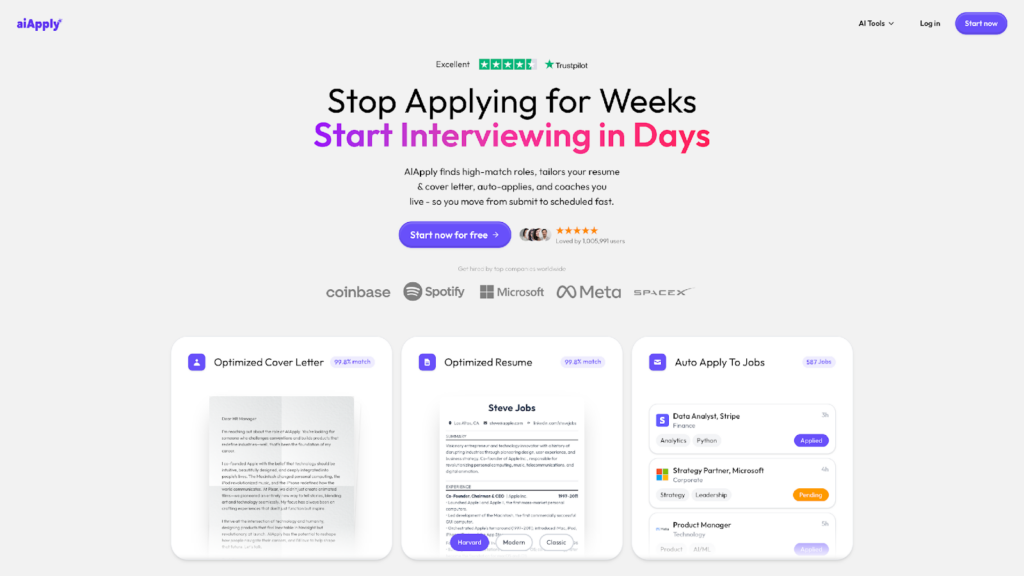
Modern AI tools can help you apply to many jobs at scale without sacrificing customization. At AIApply, we’ve built a complete suite of tools designed to solve exactly this problem:
AI-Powered Resume and Cover Letter Tailoring
Instead of manually rewriting your resume for each job, AIApply’s AI can analyze a job description and instantly tweak your resume or cover letter to highlight the right skills and keywords. This ensures each application is relevant to the job requirements (a must for passing ATS filters).
Why it matters:Recruiters spend on average just on an initial resume scan, so keyword alignments and sharp format make a huge difference.
Auto-Apply Services
Our Auto Apply feature can literally apply to jobs for you:
• AIApply’s Auto Apply crawls job boards and submits your application to hundreds of matched postings per your criteria, with one click
• Uses algorithms to find jobs that fit your profile, fill out the applications, and even handle tedious repetitive questions
• Combines volume with intelligence. Your documents are auto-optimized for each role
It’s a way to cast a wide net without spending 40 hours a week on applications.
Application Tracking and Analytics
Keeping track of 50+ applications is tough. AIApply includes dashboards to:
- Manage where you’ve applied
- Track which stage each application is in
- Send reminders to follow up
This prevents missed opportunities and helps you focus your efforts where they’re paying off.
Interview Prep on Standby
Once your increased applications start yielding interviews, AI can help there too. Tools like AIApply’s Interview Buddy can coach you in real-time so that you convert more of those interviews into offers. That way, your hard-won interviews aren’t wasted.
The Results Speak for Themselves
Candidates who leverage AI and automation can significantly shorten their job search. By handling the heavy lifting of volume and keeping quality high, these tools help you cover more ground in less time.
Our data at AIApply shows that users who use the full AI toolkit (resume + cover letter builders, auto-apply, interview prep) are up to 80% more likely to secure a job in a given timeframe than those going the traditional route. Essentially, you’re working smarter, not just harder.
Pro Tip: Even if you use AI to speed things up, stay engaged in the process. Review the applications going out on your behalf, make tweaks where needed, and continue networking in parallel. Technology is a force multiplier, but your personal touch and decision-making still play a crucial role in landing that job.
Final Thoughts: Stacking the Odds in Your Favor
So, how many applications does it really take to get a job?
It could be 30. It could be 300.
The honest truth is that you usually have to play a volume game, but you can rig the game in your favor by being strategic:
✓ Expect to Put in the Numbers
Knowing the stats upfront helps set realistic expectations. Don’t be disheartened if the first 10 or 20 applications don’t bear fruit. That’s normal in today’s market. Many job seekers will ultimately send triple-digit applications before landing somewhere, especially if relying only on online portals.
✓ Maximize Your “Hit Rate” Per Application
Rather than just lobbing out applications blindly, take steps to improve the success rate of each one. Tailor your resume, write a targeted cover letter, and try to include a referral or at least a personal note to a recruiter or hiring manager. Turning a 1% success rate into even 5% by smart targeting means far fewer total applications needed for an offer.
✓ Leverage Your Network and Get Creative
If 100 applicants are competing on the job boards, find a way to stand out or bypass the line. Attend industry events, message folks on LinkedIn, request informational interviews. Human connections can open doors that formal applications won’t. Remember, a huge portion of hires never come from the front-door application process at all.
✓ Use the Tools at Your Disposal
This is arguably the best time in history to be a job seeker in terms of technology. You have AI assistants to help craft your resume, services that auto-apply to jobs, and platforms that can connect you with hiring managers. These can dramatically cut down the manual effort and time it takes to hit high application numbers.
If you feel overwhelmed by the idea of sending 100+ resumes, consider letting AIApply shoulder some of that workload while you focus on networking and interview prep.
✓ Stay Resilient and Strategic
Job hunting can be a grind, but knowing the math can be empowering. If you haven’t gotten an interview after 50 applications, it’s not that you “failed.” You might be right on track statistically, or it’s a sign to refine your approach.
Track your metrics: How many apps per interview are you getting? Is it taking 20 applications for one callback, or 50? Use that data to adjust. Maybe you need to improve your resume, or maybe you need to shift to roles that better match your experience.
In the end, you only need one “yes” (one job offer) to make all those applications worth it. By understanding the math behind the process, you can manage your expectations and tweak your strategy to get that “yes” faster. Persistence pays off, especially when paired with smart tactics.
So keep at it, use the insights above to work smarter, and remember that every application submitted (or every connection made) is one step closer to the opportunity you’ve been striving for.
Frequently Asked Questions
How many job applications should I submit before I get worried?
There’s no magic number, but career experts suggest that applying to 50–100 jobs without any interviews might signal it’s time to reassess your approach. Check if your resume is ATS-optimized, ensure you’re tailoring applications to each job, and consider getting feedback from mentors or career coaches. Remember, the average job seeker needs 30–100+ applications, so don’t panic if you’re within that range, but do use the data to improve your strategy.
Is it better to send 10 customized applications or 50 generic ones?
Quality almost always beats quantity. Studies show that 10 carefully tailored applications can yield better results than 50 generic ones. Each customized application has a higher success rate (potentially 5–10× higher) than a spray-and-pray approach. However, with AI tools like AIApply, you don’t have to choose. You can send high volumes of customized applications efficiently.
How long does the average job search take in 2025?
The average job search in 2025 takes about 3–6 months for most professionals, though this varies widely based on industry, experience level, and job market conditions. Entry-level candidates and career changers often take longer (6+ months), while in-demand specialists might land roles in weeks. Using AI-powered tools and maintaining a consistent application pace can significantly shorten this timeline.
What’s the success rate of employee referrals compared to cold applications?
Employee referrals have about a 30% success rate, meaning nearly 1 in 3 referred candidates gets hired. In contrast, cold online applications have only a 0.1–2% success rate. This means a single referral can be worth 40+ random applications in terms of your chances of getting hired.
How can I avoid burnout when sending so many applications?
Pace yourself with a sustainable weekly goal (10–15 quality applications), use AI tools like AIApply to automate repetitive tasks, and balance application time with networking and skill development. Remember that consistency beats intensity. It’s better to send 10 applications per week for 10 weeks than 100 in one week. Also, don’t take silence or rejection personally; it’s normal in today’s market and doesn’t reflect your worth.
Do applicant tracking systems (ATS) really reject 75% of resumes?
Yes, research shows that approximately by ATS before a human ever sees them. These systems scan for specific keywords, formatting, and qualifications. To beat ATS filters, ensure your resume includes relevant keywords from the job description, uses standard formatting (avoid tables, graphics, or unusual fonts), and is saved in ATS-friendly formats like .docx or PDF. AIApply’s Resume Scanner can analyze your resume for ATS compatibility and suggest improvements.
Should I follow up after submitting an application?
Yes, but strategically. Wait about 1–2 weeks after applying, then send a brief, professional email to the hiring manager or recruiter expressing continued interest. Mention something specific about why you’re excited about the role and the company. Research shows that candidates who follow up can double their callback rate. However, don’t follow up more than once or twice, as this can be counterproductive.
Is networking really more effective than applying online?
Absolutely. Research shows that , not cold applications. A referred candidate is 10× more likely to get an interview than a non-referred one. That said, networking and applying aren’t mutually exclusive. The most effective job search combines both approaches, ideally with the 80/20 rule (80% networking, 20% applications).
Sources: Recent hiring studies, career industry reports and surveys from 2024–2025 were used to inform the data points above, including analyses by career experts, hiring platform reports, and job market statistics. All statistics are as of 2024–2025; remember that job market conditions can change, so it’s wise to seek out the latest data for your industry and region.