
| The right framework drives performance and scalability in custom software development. Custom software development services offer more flexibility than off-the-shelf software. Ext JS is ideal for enterprise apps, giving precise control over complex, data-heavy projects. |
Choosing the right and most popular JavaScript frameworks is critical in Custom software development. It influences performance, scalability, and how efficiently your team moves through the development process. A poor choice can result in costly rework or limitations that slow growth.


It determines how well an application adapts to changing business needs. The right choice also ensures long-term stability. It enables rapid transmission of updates without interfering with business activities.
Software developers often compare frameworks and JS libraries to find the most efficient path for creating custom software. Ext JS, a powerful JS library, is a strong contender for customized software development in complex, data-heavy environments.
Unlike off-the-shelf solutions, it gives developers precise control over every feature, ensuring the application meets enterprise requirements without sacrificing what matters.
The Role of Frameworks in Custom Software Development
| Frameworks give structure and speed to Custom software development. This is really helpful for building secure and scalable applications that manage complex data. The right choice boosts performance, integration, and maintenance. |
In a custom software development project, a framework provides the base structure for the application. Businesses choose custom solutions when shelf software cannot meet their exact needs. Frameworks speed up web application development by offering pre-built modules and a consistent architecture.
Custom software is developed quickly, with fewer errors, by a skilled development team. In enterprise software development, frameworks help standardize development stages.
Thus, the code does not need to be repeated. UI libraries, such as Ext JS, make it easy to build responsive, feature-rich interfaces.
Scalability is a key advantage. Frameworks handle customer data and sales data efficiently, even as workloads grow. In web app development, optimized code and security features come built in. They also support iterative development, allowing quick testing and deployment.
Choosing the right framework requires clear criteria. Performance, scalability, and integration options are critical. Delivery speed is impacted by UI richness and the learning curve.
Community support matters for long-term maintenance. A strong ecosystem provides plugins, updates, and troubleshooting resources.
With the right choice, custom software solutions become easier to build, maintain, and evolve. Frameworks are not just tools; they provide the basis of effective software development.
Ext JS
| Ext JS, which is an Extended JavaScript Framework, is mainly designed for enterprise applications. It gives many pre-built UI components and handles large datasets efficiently. You can use one codebase, and it works nicely with any device. |
Ext JS is a mature JavaScript framework for enterprise-grade applications. It is valued among software development platforms for stability and scalability. It enables custom software development that meets complex business needs and supports long-term business goals.
The UI library packs in grids, charts, forms, and other advanced widgets. These components work smoothly with existing workflows. They can directly integrate into a system. It’s basically designed to deal with complex, large datasets. So, it can efficiently handle the performance of high-volume apps.
Ext JS delivers a consistent experience across desktop, tablet, and mobile with one codebase. This helps to reduce the maintenance and increase delivery timelines. This can increase the system reliability by integrating theming, layouts, and debugging tools.
Ideal use cases include enterprise dashboards, business intelligence platforms, and software solution deployments. It helps companies automate processes, modernize legacy software, and connect existing systems during digital transformation. With deep industry expertise, a skilled software development company can build bespoke software that supports precise business objectives.
Ext JS combines strong architecture with practical tooling. Its modular design allows easy scaling and customization for evolving requirements. For data-intensive, mission-critical environments, it remains a proven choice in modern application development software.
Other Popular Frameworks
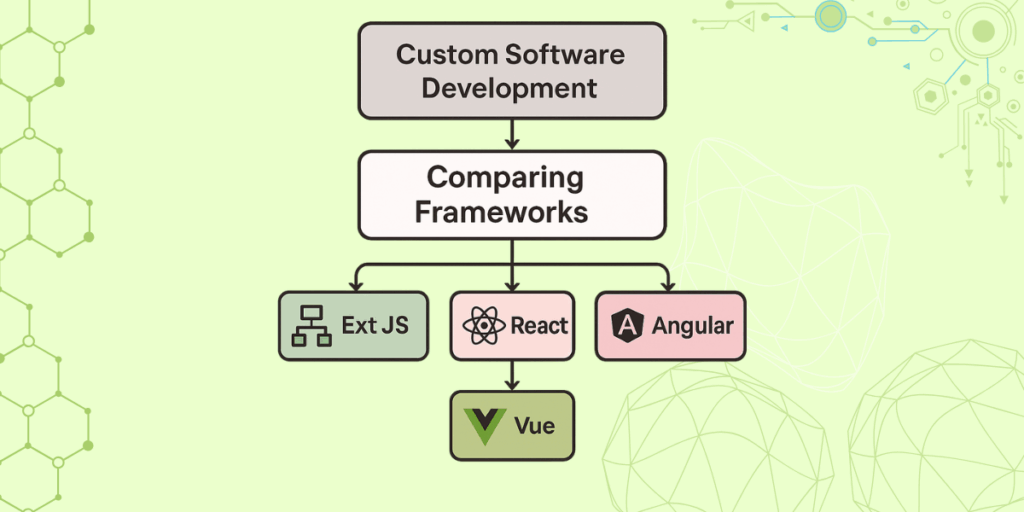
React, Angular, and Vue.js each solve different business needs. React gives flexibility but needs extra libraries. Angular is strong but takes more time to learn. Vue.js is quick to learn and easy to work with, but it falls short on large-scale projects. Ext JS works nicely for large enterprises with data-heavy systems.
Different frameworks help at different stages of development and handle business challenges in their own ways. Every framework is flexible, but the trade-off in cost and long-term value is not the same. Comparing them helps project managers and teams align custom workflows with industry expertise.
1. React
React is widely used for custom development because of its flexibility and huge ecosystem. It supports mobile apps, web interfaces, and tailor made software through API driven development. Project managers prefer it when business operations demand quick scaling across software systems.
By default, React doesn’t have grids, charts, or layouts. So, to use them, developers usually bring in extra libraries to cover those parts. It takes longer to set up, especially for in-house teams under pressure and facing strict industry rules. A cost benefit analysis often shows Ext JS is faster to adopt in data-heavy environments.
Despite that, React remains strong where cutting edge technologies and community-driven updates matter. Most of the teams use this to automate tasks. It makes business processes smoother and sets up workflows shaped around the user’s needs. It delivers business forward outcomes but requires extra effort compared to Ext JS.
2. Angular
Angular is a complete framework with strong backing from Google. It lets businesses build custom software that can grow through different stages.
It also supports both in-house teams and large enterprise systems. Its main strength is delivering software tailored to business needs. It also stays aligned with strict industry regulations.
Compared to Ext JS, Angular has a steeper learning curve. It also handles massive datasets less efficiently, making cost benefit analysis critical for project managers handling complex workflows. Still, its built-in tools streamline project management and improve long-term business processes.
Angular is a good choice for teams with industry knowledge and strong project management skills. It gives the features that can automate tasks. So, the business operations run smoothly. It brings strong business value, but setup and training usually take more time compared to Ext JS.
3. Vue.js
Vue.js has a lightweight structure, and it’s quick for developers to learn. It works effectively with small projects and mobile apps, which need quick delivery. Businesses often use it to develop custom software at early development stages.
Compared to Ext JS, Vue lacks enterprise-ready depth in grids, charts, and advanced workflows. This limits its value when tailoring solutions to large-scale business challenges or strict industry regulations. Project managers usually find Ext JS more aligned with custom workflows and long-term business operations.
Still, Vue provides flexible systems for teams seeking quick wins. It simplifies API driven development, allowing developers to automate tasks with less complexity. The real advantage is speed, but for bigger enterprise needs, Ext JS offers better value.
Feature Comparison Table
| Feature / Framework | Ext JS | React | Angular | Vue.js |
| Rich UI Components | Built-in and ready to use | Needs additional libraries | Limited set included | Requires external plugins |
| Large Data Handling | Optimized for heavy datasets | Requires manual setup | Moderate capabilities | Limited support |
| Cross-Platform | Full support | Partial support | Full support | Partial support |
| Development Speed | Fast with pre-built tools | Slower initial setup | Medium pace | Medium pace |
How to Choose the Right Framework
| The choice of the right framework depends on the project’s complexity and size. It should handle integrations well and include useful features to improve efficiency. Users remain satisfied because of strong support and feedback. |

Choosing the right framework needs clear project support. Small applications with limited needs may only require current solutions already in place.
Big or complex projects need a close look at the requirements. You also have to think about long-term value. Strong ongoing support is just as important.
A development company needs to fit the project’s complexity to the right tech stack. Frameworks with unique features can reduce development time while still meeting specific business needs. Stakeholder feedback is critical because it highlights what works in existing software and where improvements are needed.
New software should integrate smoothly with existing platforms to increase efficiency. A framework with knowledge sharing keeps the team aligned and protects intellectual property. This is particularly important for sectors that have complex systems, like the healthcare industry’s patient portal.
Customer satisfaction depends on how easily the framework adapts to change. An agile mindset allows the business to respond quickly while keeping development structured. The ability to incorporate stakeholder feedback during iterations leads to better results.
Security, scalability, and support for complex projects should be prioritized. Picking a framework with ongoing support helps keep things stable over time and reduces risks. Balancing scope, complexity, and requirements helps businesses pick a framework that works now and later.
Why Ext JS Stands Out for Custom Software Development
| Ext JS gives enterprises ready-made tools that fit each stage of development. It can process large datasets without slowing down and connects easily with other systems. The framework also cuts build time and keeps apps consistent across devices. |
Ext JS delivers enterprise-grade features from the start, making it dependable across different development stages. The components are built to match complex business needs, so the technical work stays in line with project requirements. This approach makes it easier for the software to grow as the project’s scope expands.
Its main advantage is that it handles large datasets. It can work nicely in handling the thousands of records efficiently without affecting the system performance. With seamless integrations into back-end systems, developers can maintain efficiency even when working on data-heavy applications.
Development time is reduced thanks to integrated tools for grids, charts, forms, and workflows. These built-in resources simplify knowledge transfer within teams, since developers share a common environment. As a result, new contributors can join projects without long onboarding cycles.
Cross-platform consistency is another core strength of Ext JS. Applications keep the same look and behavior across browsers and devices. This can help in reducing the extra testing work. Ext JS aligns with project needs and delivers reliably. No matter if the project is small or large.
Conclusion
| React, Angular, and Vue each offer strong features for modern web development. They are flexible, widely used, and reliable across various development stages. But when stability and performance at scale are critical, Ext JS has the edge. |
The framework is tailored specifically for enterprise applications that manage heavy data loads. Its ready-made components cut down on complexity while still allowing deep customization. This balance helps teams deliver stable, data-driven systems.
In custom software development, growth should not come at the cost of speed. As the project grows and user needs rise, Ext JS supports in preserving performance. That’s why companies rely on it in places where even a short downtime isn’t an option.
Unlike lighter frameworks, Ext JS includes structured tools that guide teams from design through deployment. Its architecture fits well with sectors like healthcare, finance, and logistics. These industries depend on consistent and predictable performance.
React, Angular, and Vue handle many development needs, but Ext JS proves stronger for large enterprise systems. It offers a stable, scalable base tailored specifically for critical operations. For long-term growth, it provides a reliable path forward.
FAQs
What Types Of Applications Can I Build With Ext JS?
Ext JS is specifically designed to deal with data-heavy web apps, dashboards, ERP systems, and admin tools. It nicely manages the large datasets. While ensuring apps are smooth and responsive on all platforms.
Is Ext JS Good For Enterprise Application Development?
Yes. Ext JS is primarily built to deal with enterprise-scale applications. Such applications demand reliability, high performance, and scalability. Its structure and built-in components make it reliable for critical systems, where every second counts.
Is Ext JS Only For Enterprise Applications?
No. Ext JS can run medium-sized corporate applications, but it is most effective in enterprise systems. Developers often use it where strong data handling, complex interfaces, and long-term maintainability are required.
Is It Worth Learning Ext JS In 2025?
Yes. Ext JS remains valuable in 2025 for industries relying on complex data-driven systems. A lot of enterprises continue relying on it. So, it’s good to have skills in this to boost career opportunities.
Comparing Frameworks For Custom Software Development: Which Is Right For You?
Choosing a framework comes down to project size, complexity, and performance goals. Ext JS is strong for big, data-heavy applications. React, Angular, and Vue are good choices if dealing with smaller, flexible projects.
How Does Ext JS Compare To React For Enterprise Applications?
Ext JS provides enterprise-ready tools right out of the box, while React is lightweight and versatile. For large, data-focused projects requiring reliability and scalability, Ext JS typically reduces complexity and ensures consistent performance.
How Does Angular Differ From Ext JS In Custom Software Development?
Angular provides flexibility and modular development, while Ext JS delivers a structured, complete framework. Ext JS works better for enterprise projects that need powerful data grids and complex user interfaces.
Why Would A Business Choose Ext JS Over Vue?
Vue is a good fit for smaller, flexible projects. Ext JS is chosen for enterprise systems where stability, strong data handling, and long-term support are essential.
Which Framework Offers Better Long-Term Scalability?
Ext JS is often preferred for long-term scalability in enterprise systems because of its solid tools and reliability. React, Angular, and Vue can scale too, but need extra integrations.
What Factors Should I Consider Before Selecting A Framework?
Look at factors like data complexity, scalability, team skills, and long-term upkeep. Ext JS fits enterprises with heavy workflows, while React, Angular, and Vue work better for flexible modern apps.
Discover how Ext JS can power your next custom software project — start your free trial today!