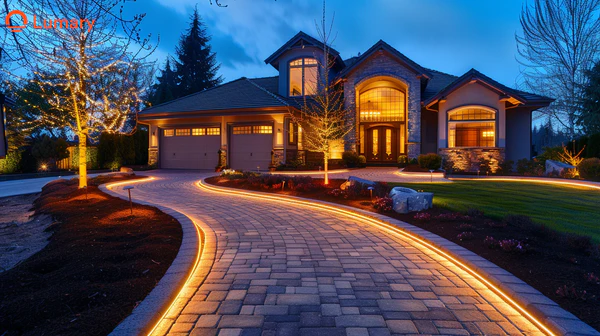
When outdoor LED strip lights are evaluated in controlled environments, performance often appears predictable and stable. Laboratory tests confirm waterproof ratings, electrical safety, and luminous output. Yet once installed outdoors, lighting systems are exposed to far more complex and unforgiving conditions than any test chamber can fully replicate.


From tropical humidity and coastal salt spray to desert heat and subzero winters, outdoor environments vary dramatically across regions. These differences explain why LED strip lights that perform well in one location may fail prematurely in another. As outdoor lighting becomes an integral part of architecture, infrastructure, and public space design, understanding how lighting systems respond to environmental stress is no longer optional.
In this context, the best waterproof outdoor LED strip lights are defined not only by their construction, but by how reliably they perform across diverse and extreme outdoor environments. This article examines how climate, geography, and long-term exposure affect outdoor LED strip performance—and what separates durable solutions from short-lived ones.
Environmental Stress: More Than Just Water
While water resistance is a central requirement for outdoor lighting, it is rarely the only challenge. Environmental stress is cumulative, and failures often result from multiple factors acting together over time.
The Interaction of Climate Factors
Outdoor LED strip lights are typically exposed to combinations of:
- Moisture and humidity
- Ultraviolet radiation
- Temperature extremes and rapid thermal cycling
- Airborne contaminants such as dust, salt, and pollutants
Each of these factors can degrade materials and electrical components. When combined, their effects accelerate. A lighting system that is technically waterproof may still degrade rapidly if other environmental stresses are not properly addressed.
High-Humidity and Tropical Environments
Tropical and subtropical regions present some of the most demanding conditions for outdoor LED strip lighting. High humidity is constant rather than seasonal, and temperatures often remain elevated year-round.
Continuous Moisture Exposure
In humid climates, moisture does not only come from rainfall. Condensation forms nightly as temperatures drop, creating persistent damp conditions even in sheltered locations. Over time, this moisture can migrate through microscopic gaps in seals and encapsulation layers.
The best waterproof outdoor LED strip lights designed for tropical use typically feature:
- High-elasticity silicone encapsulation
- Chemically stable adhesives
- Reinforced end-cap sealing
Products relying on rigid coatings or minimal sealing often suffer gradual ingress, leading to corrosion or electrical leakage.
Biological and Chemical Challenges
Warm, humid environments also promote biological growth such as mold and algae, which can accumulate on lighting surfaces. Additionally, airborne chemicals from vegetation or urban pollution may interact with encapsulation materials, accelerating discoloration or surface degradation.
Coastal Regions and Salt Spray Exposure
Coastal environments pose unique challenges that go beyond moisture alone. Salt carried by sea air is highly corrosive and can penetrate lighting systems over time.
Salt as an Accelerant of Failure
Salt particles settle on outdoor LED strips and dissolve in moisture, creating conductive pathways that increase the risk of corrosion and electrical shorting. Metal components, solder joints, and connectors are particularly vulnerable.
High-performing outdoor LED strip lights intended for coastal use often incorporate:
- Corrosion-resistant PCB finishes
- Sealed connectors designed to resist salt intrusion
- Materials tested under salt spray conditions
Without these measures, even products rated for outdoor use may experience rapid degradation near the ocean.
Hot and Arid Climates: Heat and UV Dominance
In desert and high-sunlight regions, water exposure may be limited, but heat and ultraviolet radiation dominate environmental stress.
UV Radiation and Material Aging
Prolonged exposure to sunlight breaks down many polymers, causing:
- Yellowing or clouding of encapsulation
- Loss of flexibility
- Surface cracking that compromises waterproof integrity
The best waterproof outdoor LED strip lights for these environments rely on UV-stabilized silicone compounds and diffusers designed to maintain optical clarity over time.
Thermal Load and Heat Dissipation
High ambient temperatures reduce the margin for heat dissipation. If an LED strip cannot effectively release heat, internal temperatures rise rapidly, accelerating lumen depreciation and color shift.
In hot climates, outdoor LED strip systems are often paired with aluminum mounting profiles to improve thermal performance without compromising waterproofing.
Cold Climates and Freeze-Thaw Cycles
Cold and temperate regions introduce a different set of challenges. While moisture may be seasonal, freeze-thaw cycles place severe mechanical stress on materials.
Expansion, Contraction, and Seal Fatigue
Water that enters microscopic gaps can freeze and expand, widening those gaps and further compromising seals. Repeated cycles of freezing and thawing gradually weaken encapsulation layers and adhesives.
Outdoor LED strip lights designed for cold climates typically emphasize:
- Flexible waterproof materials that remain elastic at low temperatures
- Robust sealing at joints and terminations
- Resistance to embrittlement
Rigid encapsulation systems that perform adequately in warm climates often fail in these conditions.
Urban Pollution and Industrial Environments
In dense urban and industrial areas, outdoor lighting is exposed to airborne contaminants that are often overlooked during product selection.
Dust, Soot, and Chemical Residue
Particulate matter from traffic, construction, and industrial processes settles on outdoor LED strips, sometimes combining with moisture to form conductive or abrasive residues. Over time, this buildup can:
- Reduce light output
- Degrade encapsulation surfaces
- Increase electrical leakage risk
The best waterproof outdoor LED strip lights in these environments are designed with smooth, non-porous surfaces that resist accumulation and are easier to clean during maintenance cycles.
Mechanical Stress from Installation and Structure
Environmental performance is also influenced by how and where LED strips are installed.
Structural Movement
Outdoor structures expand and contract with temperature changes. Bridges, façades, railings, and handrails all move subtly over time. LED strips mounted rigidly without allowance for movement experience continuous mechanical stress.
Flexible waterproof systems accommodate this movement without cracking, while brittle materials eventually fail.
Wind and Vibration
In exposed locations, wind-induced vibration can place additional stress on mounting points and internal solder joints. Durable outdoor LED strip designs account for these forces through reinforced construction and strain relief at critical points.
Regional Performance Differences: Lessons from Global Installations
Global outdoor lighting projects have revealed clear performance patterns linked to environmental conditions.
- In Southeast Asia, high humidity and heat demand superior moisture resistance and thermal stability.
- In Northern Europe, freeze-thaw resilience and long-term sealing integrity are critical.
- In Middle Eastern regions, UV resistance and heat dissipation dominate performance outcomes.
- In coastal North America, salt spray and corrosion resistance are primary concerns.
The best waterproof outdoor LED strip lights are those engineered with these regional variations in mind rather than relying on a one-size-fits-all approach.
Testing for Environmental Realism
To evaluate performance across environments, manufacturers increasingly adopt testing protocols that simulate combined stresses rather than isolated conditions.
Meaningful tests include:
- High-humidity aging at elevated temperatures
- UV exposure combined with thermal cycling
- Salt spray followed by electrical performance verification
- Mechanical flex testing under temperature extremes
These tests provide insight into how products will perform over years of outdoor exposure, not just days in a lab.
The Role of Experience in Product Design
Manufacturers with long-term experience in outdoor linear lighting tend to design products based on field feedback rather than theoretical performance alone. Lessons learned from failed installations often drive improvements in materials, sealing techniques, and quality control.
Some established lighting manufacturers, particularly those serving architectural and signage markets, have refined their outdoor LED strip offerings by analyzing real-world performance across multiple climate zones.
Conclusion: Environmental Performance Defines True Quality
Outdoor environments are diverse, complex, and often unforgiving. Waterproof ratings alone cannot predict how LED strip lights will perform once exposed to years of climate stress, pollution, and structural movement.
The best waterproof outdoor LED strip lights are those that maintain optical quality, electrical safety, and mechanical integrity across a wide range of environmental conditions. As outdoor lighting continues to expand globally, performance in harsh real-world environments will remain the defining benchmark of quality.