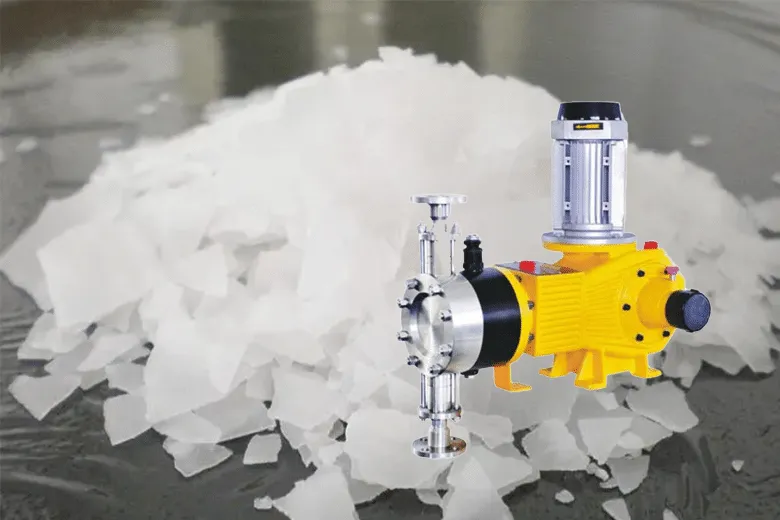
Caustic soda (NaOH) is a foundational chemical in many industries—water treatment, chemical manufacture, textile, pulp & paper, and more. But dosing or circulating caustic incorrectly risks equipment damage, process upset, leaks, or regulatory violations. Every plant that handles NaOH needs a chemical pump for caustic soda that meets exacting standards.


If you are an engineer, maintenance manager, or procurement decision maker, this guide will help you understand what makes NaOH service so demanding and how to choose the right pump so you avoid costly mistakes.
Why Caustic Soda (NaOH) Requires a Specialized Pump
Although caustic soda is a basic chemical, its aggressiveness under certain conditions makes it far from benign. The high pH environment attacks many materials. Standard pump designs often fail prematurely when exposed to concentrated or hot NaOH.
Key challenges:
- Chemical attack: Caustics can corrode metals, degrade elastomers, and weaken coatings.
- Thermal stress: Elevated temperatures accelerate chemical attack and stress materials.
- Concentration effects: Higher NaOH concentrations increase ionic attack.
- Impurities & solids: Chlorides, sulfates, and suspended particles worsen erosion or crevice corrosion.
- Intermittent duty: Pumps often must start and stop, adding mechanical stress.
Common Failure Mechanisms in Caustic Pump Service
- Seal corrosion and leakage: Over time, elastomeric seals crack, harden, or fail under alkali exposure.
- Stress corrosion cracking: Metals under tensile stress may develop slow-growing cracks.
- Erosion / abrasion: Solid particles or precipitates wear impellers, liners or seal faces.
If you attempt to run NaOH on a generic pump, these failure modes will surface early, often in months.
Key Criteria for Selecting a Chemical Pump for Caustic Soda
Selecting a pump for NaOH is not just about matching flow and head. You must design for durability, safety, and maintenance.
Important criteria:
- Material compatibility
- Must resist ionic attack, preserve strength, resist embrittlement.
- Consider polymers (PVDF, PFA), lined metals, or hybrid designs.
- Temperature, concentration, and pressure margins
- Pumps should withstand transient peaks, not just nominal duty.
- Duty cycle & flow match
- Avoid running far off the pump’s optimal efficiency point.
- Seal design and containment
- Use double seals, buffer zones, purge paths to catch leakage.
- Maintenance access & modularity
- Ability to replace seals, liners, impellers without full removal.
Material Options & Trade‑offs
| Material / Design | Advantages | Limitations / Considerations |
| All‑polymer (PVDF, PFA) | Outstanding corrosion resistance, smooth surfaces | Lower pressure rating, thermal limits |
| Metallic with polymer lining | Structural strength + chemical barrier | Risk of liner failure at seams |
| Hybrid designs (metal + polymer) | Balanced strength and resistance | More complex design, higher cost |
Your choice must align with fluid composition, temperature, pressure, and expected life cycle.
Pump Types Suitable for Caustic Soda & Their Strengths / Weaknesses
Knowing pump type options allows you to pick one suited for your unique duty. Below are the main classes used in NaOH service.
- Diaphragm / dosing pumps: Often used for precise addition or control-phase dosing.
- Magnetic drive (sealless) pumps: Eliminates traditional mechanical seals in corrosive environments.
- Vertical sump / cantilever pumps: Ideal for tanks, sumps, or when fluid level varies.
- Peristaltic / hose pumps: Suitable for batch or intermittent transfer especially when full isolation is preferred.
When to Use Each Type
- High accuracy dosing vs bulk transfer: Diaphragm or metering pumps shine for low‑volume, precise dosing; use magnetic or sump pumps for bulk flow.
- Corrosive vs abrasive service: Magnetic and lined designs resist corrosion; for slurries or solids, peristaltic or robust lined types might be better.
- Continuous vs intermittent duty: Diaphragm models are good for intermittent dosing. For continuous recirculation, robust centrifugal or sealless magnetic pumps are better.
Selecting the wrong pump type is a frequent root of field failure.
Design Enhancements for Long Life in Caustic Service
Even with correct pump type, proper design enhancements make the difference between months of life and decades. Good design anticipates failure modes and counters them proactively.
Key design features:
- Double or barrier seals with buffer zones
- Secondary paths to capture leakage before exposure.
- Flush / purge systems
- Small continuous flow to clear salt deposits or corrosive buildup around seals and clearance zones.
- Modular construction
- Replace parts such as liners, impellers, or seals in field without removing the entire pump.
- Thermal management
- Use jackets, insulation, or cooling to moderate temperature spikes in operation.
Best Practices to Prevent Leaks & Failures
- Always include purge lines with clean fluid to reduce material deposition.
- Use soft-start or ramp control to reduce hydraulic shocks at startup.
- Monitor vibration, temperature, flow drift regularly and plan inspections accordingly.
- Use buffer fluids or barrier fluids in advanced sealing systems for extra safety.
Well-designed enhancements extend the pump life far beyond standard units.
Real‑World Use Cases: Caustic Pump Deployments Done Right
Theory is useful—but real plant experience gives confidence. Below are common application examples and how they validate design decisions.
Typical Applications
- Caustic dosing in Effluent Treatment Plants (ETP): precise adjustment to neutralize acidic streams.
- Caustic circulation loops in chemical plants: recirculation through reactors, washers, or scrubbers.
- Caustic handling in pulp & bleach operations: high concentrations, high temperature, variable flows.
Metrics You Should Monitor Post‑Installation
- Number of seal failures or leaks per year
- Flow or head drift compared to baseline pump curve
- Shifts in vibration, bearing or motor load, temperature
- Periodic visual inspection of liner wear or impeller thinning
If drift or degradation appears, that tells you either design margins were too tight or operating conditions have changed.
How to Vet a Manufacturer Before Purchase
Your pump supplier can make or break system reliability. Vet carefully to avoid surprises.
- Ask for compatibility validation reports using your exact caustic fluid sample.
- Ensure local support and spare parts presence to reduce downtime.
- Demand field references from similar industries handling caustic service.
- Get a detailed total cost of ownership (TCO) estimate, not just a price quote.
Common Buyer Mistakes to Avoid
- Focusing only on CAPEX (lowest upfront cost)
- Overlooking long-term seal or liner replacement costs
- Ignoring delays in spare parts and field service availability
- Failing to verify actual materials in each wetted component
A supplier that fails these checks is a risk you don’t need.
Conclusion & Next Steps for Engineers & Buyers
Precision isn’t optional when working with caustic soda. The wrong pump creates leaks, process failures, safety incidents, and financial loss. A well‑chosen chemical pump for caustic soda brings control, stability, safety, and longer service life.
Here are your takeaways:
- Choose pump type based on your operational duty, not just flow.
- Pick materials that survive your fluid, temperature, and impurities.
- Design with double seals, purge systems, modular access.
- Vet your supplier for compatibility, spares, field support, and total cost.
Next steps:
- Send fluid sample to selected vendors for compatibility testing
- Request to inspect an installed pump in a similar environment
- Compare spare delivery times and field service guarantees
- Ask for performance data, failure logs, and lifecycle projections
Make your pump choice a strategic one, not a gamble. When you invest in precision early, you avoid years of headaches, costly repairs, and lost production.