Modern industrial environments are generating more data than ever before. From production line metrics to supply chain logistics, this information holds the key to unlocking new levels of efficiency, productivity, and innovation. The challenge lies in accessing and interpreting this data in a meaningful way. This is where the powerful combination of the Industrial Internet of Things (IIoT) and advanced Human-Machine Interfaces (HMI) becomes transformative.


This guide explores the world of Industrial Automation & IIoT HMI Solutions. We will break down what these technologies are, how they work together, and the significant benefits they bring to various industrial sectors. By understanding these solutions, businesses can learn how to turn raw data into actionable insights, streamline complex processes, and gain a significant competitive edge in a rapidly evolving market.
What is an HMI?
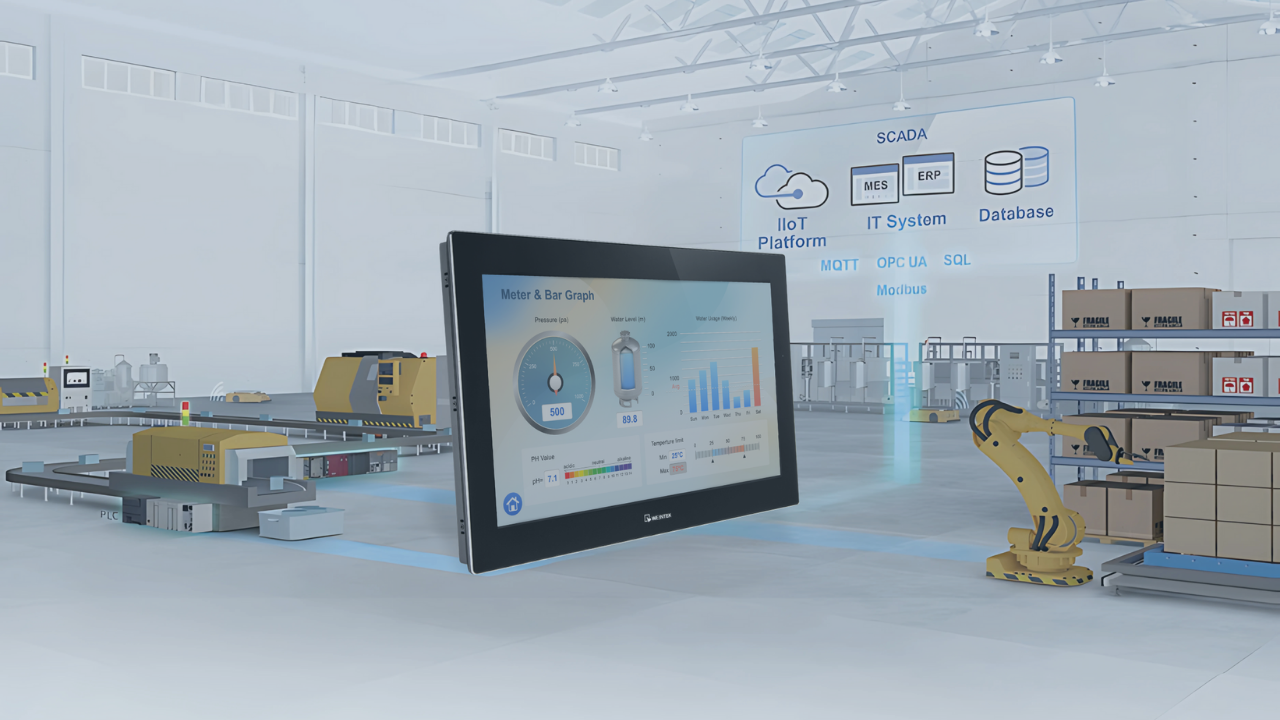
A Human-Machine Interface (HMI) is essentially the user’s dashboard for an industrial system. It’s a graphical interface—often a touchscreen panel, computer monitor, or even a mobile device—that allows operators to interact with and control machinery and production processes.
Think of it as the central command center. Through an HMI, an operator can:
- Monitor production status in real-time.
- Start or stop processes.
- Adjust settings and parameters.
- Acknowledge alarms and troubleshoot issues.
- View historical data and performance trends.
Traditional HMIs provided a localized view of a specific machine or process. While valuable, their scope was limited. Modern HMIs, however, have evolved far beyond simple control panels.
The Evolution: Integrating HMI with IIoT
The Industrial Internet of Things (IIoT) refers to the network of interconnected sensors, instruments, and other industrial devices that collect and share data. When you integrate HMI technology with the IIoT, you create a far more powerful and comprehensive system.
An IIoT-enabled HMI doesn’t just communicate with a single machine. It acts as a gateway, collecting data from countless sensors and devices across the entire facility—and sometimes even across multiple locations. This data is then processed, visualized, and presented in a unified, intuitive interface.
This integration is the core of modern Industrial Automation & IIoT HMI Solutions. It transforms the HMI from a simple control interface into a rich, data-driven window into the entire operational landscape.
Key Benefits of Industrial Automation & IIoT HMI Solutions
Adopting an integrated HMI and IIoT strategy offers a multitude of advantages that directly impact efficiency, productivity, and profitability.
Centralized Monitoring and Control
One of the most significant benefits is the ability to monitor and manage operations from a single, centralized platform. Instead of physically checking individual machines on the factory floor, operators can view the status of all connected equipment from one HMI. This unified view simplifies management, reduces the need for manual oversight, and allows for quicker responses to operational changes.
Enhanced Data Visualization
Raw data from sensors is just a stream of numbers. Advanced HMI solutions transform this data into intuitive charts, graphs, and dashboards. This visualization makes it easy to spot trends, identify anomalies, and understand complex processes at a glance. Operators can quickly interpret key performance indicators (KPIs) like Overall Equipment Effectiveness (OEE), production rates, and downtime, enabling more informed decision-making.
Remote Accessibility and Management
The power of the IIoT extends the reach of the HMI beyond the factory walls. With cloud-based solutions, authorized personnel can securely access HMI dashboards from anywhere in the world using a computer, tablet, or smartphone. This remote access is invaluable for:
- Maintenance teams who can diagnose issues without being on-site.
- Managers who need to monitor production while traveling.
- Multi-site operations that require centralized oversight.
This capability ensures that critical operations are always within reach, improving response times and operational flexibility.
Predictive Maintenance and Reduced Downtime
Downtime is a major drain on resources. IIoT HMI solutions are instrumental in shifting from a reactive to a predictive maintenance model. By continuously collecting data from sensors on machine health—such as vibration, temperature, and power consumption—the system can identify patterns that precede equipment failure.
The HMI can then generate alerts, notifying maintenance staff of a potential issue before it leads to a breakdown. This proactive approach allows for scheduled maintenance, significantly reducing unplanned downtime and extending the lifespan of critical assets.
Improved Operational Efficiency
By providing a clear, real-time view of all processes, these solutions empower teams to identify and eliminate inefficiencies. Operators can see bottlenecks in the production line, track material consumption, and monitor energy usage. Armed with this information, businesses can optimize workflows, reduce waste, and lower operational costs.
Core Components of an IIoT HMI Solution
Building a robust industrial automation system involves several key components working in concert.
HMI Hardware
This is the physical interface the operator uses. Modern HMI panels are often ruggedized to withstand harsh industrial environments. They feature high-resolution touchscreens, powerful processors capable of handling complex graphics, and multiple communication ports (like Ethernet and serial) to connect to a wide range of industrial devices.
HMI Software
The software is the brain of the operation. It is used to design the graphical interface, configure connections to PLCs and other devices, and define how data is displayed and managed. Modern HMI software is user-friendly, often featuring drag-and-drop design tools, pre-built symbol libraries, and scripting capabilities for advanced customization.
Connectivity and Protocols
For an HMI to communicate with the vast array of devices in an industrial setting, it must support various communication protocols. These are the “languages” that different machines use to speak to each other. A versatile HMI solution will support a wide range of protocols, such as Modbus, EtherNet/IP, and OPC UA, ensuring seamless integration with existing equipment. OPC UA (Open Platform Communications Unified Architecture) is particularly important for secure and reliable data exchange in IIoT environments.
Cloud Integration
The link to the cloud is what enables remote access and powerful data analytics. The HMI acts as a gateway, securely pushing data from the factory floor to a cloud platform. This allows for long-term data storage, advanced analysis using powerful cloud computing resources, and access to dashboards from any internet-connected device.
Choosing the Right IIoT HMI Solution
With many options available, selecting the right solution requires careful consideration of your specific needs. Key factors to evaluate include:
- Scalability: Can the solution grow with your business? It should be able to support an increasing number of connected devices and users over time.
- Compatibility: Does it support the communication protocols used by your existing equipment (PLCs, drives, sensors)?
- Security: How does the solution protect your data, both on-site and in the cloud? Look for features like user authentication, encrypted communications, and secure remote access.
- Ease of Use: Is the software intuitive for both developers and operators? A system that is easy to configure and operate will be adopted more quickly and used more effectively.
- Support and Training: Does the provider offer reliable technical support and training resources to help you get the most out of your investment?
Pave the Way for a Smarter Factory
Industrial Automation & IIoT HMI Solutions are no longer a futuristic concept; they are a practical and essential tool for modern manufacturing and industrial processes. By bridging the gap between machines and operators, and by turning vast amounts of data into clear, actionable intelligence, these systems empower businesses to become more efficient, agile, and competitive.
Embracing this technology allows you to move beyond simple monitoring and control. It opens the door to a truly connected and data-driven operation, where decisions are informed by real-time insights and processes are continuously optimized. Investing in the right HMI and IIoT strategy is a critical step toward building the smart factory of the future.