


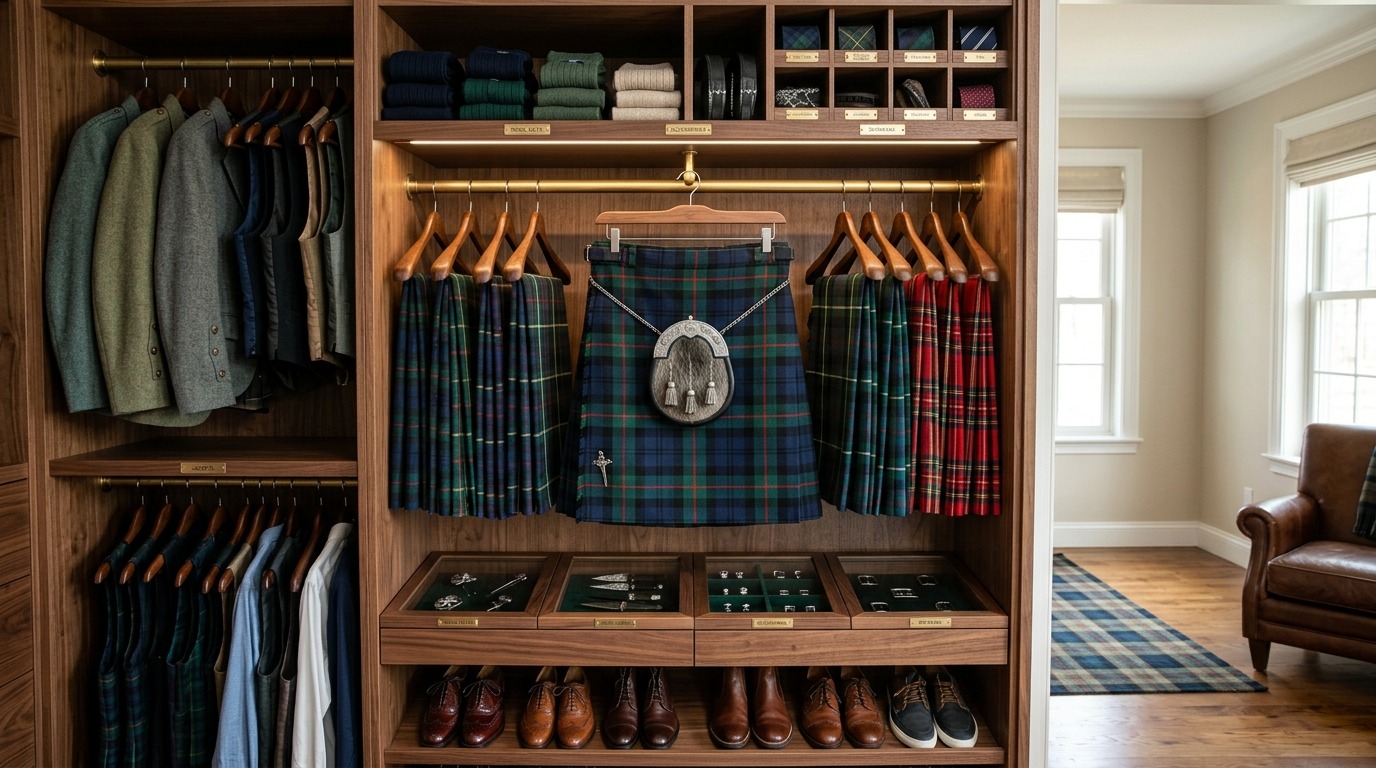
I’ve helped enough friends shop for kilts to notice a clear pattern. Most men who get into kilt-wearing don’t end up with one or two kilts in their closet. They end up with five, six, sometimes ten — but none of them are the right one.


The collections look something like this: a polyester tartan from a costume shop, a PV blend from a tourist site, a budget utility kilt from an online seller, maybe a leather kilt from a metal concert era, sometimes a sport kilt for a fun run. None of these are wrong on their own. But together, they make up a men kilt wardrobe that’s missing its single most important piece.
That piece is a real tartan wool kilt.
Not a cheap imitation. Not a wool-blend with mostly synthetic content. A genuine 100% wool kilt from a recognized mill, properly constructed, sized to the wearer’s body. The kind of kilt that anchors the entire wardrobe and makes everything else make sense.
Here’s why that one piece matters more than the other five combined.
The Wardrobe Problem Most Men Don’t Recognize
When a man’s first kilt is a polyester or PV blend, three things tend to happen.
First, he doesn’t wear it as much as he expected to. The fabric doesn’t move right. The colors look slightly off in photos. He’s vaguely aware the kilt isn’t quite delivering on its promise, even if he can’t articulate why.
Second, he buys more kilts to compensate. If the first one didn’t quite work, maybe the next one will. He adds a utility kilt for casual wear. A leather kilt for events. Maybe a sport kilt. The collection grows but the underlying problem isn’t solved.
Third, when a real occasion comes up — a wedding, a Burns Night, a meaningful Scottish event — he ends up either renting a real kilt for that one event or making do with what he has and feeling slightly underdressed.
The wardrobe has multiple kilts but no foundational kilt. It has the experimental pieces but not the cornerstone.
What a Real Tartan Wool Kilt Is
To be specific about what we’re talking about:
- 100% pure wool fabric, not blends and not synthetic
- Woven at a recognized Scottish mill — Lochcarron, House of Edgar, Strathmore, or Marton Mills are the most common
- Specified weight of either 11oz, 13oz, or 16oz
- Hand-stitched pleats that hang freely (not stitched down flat)
- 5-yard or 8-yard fabric construction depending on traditional level
- Custom-sized to the wearer at the natural waist
- Length to the middle of the kneecap
This isn’t an expensive ask in the context of menswear generally. A quality wool tartan kilt costs $250 to $500. That’s the same price range as a quality suit. And the wool kilt will likely outlast any suit you’ve ever owned.
Why Wool Specifically
The wool versus synthetic question deserves a clear answer because it’s the single biggest dividing line between authentic kilts and the rest.
Wool has properties that synthetic fabrics cannot replicate:
Drape. Real wool falls in three dimensions. The pleats swing as a coordinated unit when you walk. The apron sits flat without bunching. Synthetic fabrics, even good ones, have a slightly stiffer character that prevents this natural movement.
Color depth. Wool absorbs dye and reflects light in ways that create visual depth. A green wool tartan has multiple greens in it — slight variations across the weave that give the color richness. Synthetic dyes are typically uniform and flat by comparison.
Weight. A heavyweight wool kilt has substance that affects how it sits on the body and how it photographs. The weight isn’t a bug — it’s the feature that makes the silhouette work. Lightweight synthetic kilts can’t replicate this.
Aging. Wool gets better with age. The fabric softens, the pleats settle into the wearer’s body, the colors mellow slightly. After 20 years, a well-cared-for wool kilt looks better than it did new. Synthetic kilts degrade — pilling, color fading, pleat distortion.
Climate response. Wool insulates without trapping moisture. It breathes. It handles cold and damp weather better than any synthetic. Synthetic fabrics either trap heat (in summer) or transfer cold directly to the body (in winter).
Photographic performance. This matters more than most men realize. The events where you’ll wear a wool kilt — weddings, Burns Nights, cultural celebrations — are events that get photographed. Wool photographs beautifully. Synthetic kilts develop a slight plastic sheen under flash photography that’s instantly recognizable.
What a Real Wool Kilt Lets the Rest of the Wardrobe Be
Here’s the practical magic of having one foundational tartan wool kilt in your collection: every other kilt becomes free to be exactly what it is.
Your utility kilt doesn’t need to perform formal duty anymore. It’s a daily-wear practical piece. That’s what it’s good at.
Your leather kilt doesn’t need to pretend to be heritage-appropriate. It’s a statement piece for concerts and creative events. That’s what it’s for.
Your sport kilt doesn’t need to handle wedding photos. It’s an athletic garment. Done.
Without a foundational wool kilt, the other kilts in your wardrobe end up trying to cover for the missing piece — being asked to do jobs they’re not built for, looking out of place at events they weren’t designed for. With a wool kilt anchoring the collection, each of the other pieces gets to specialize.
This is the same principle as having one good suit. You don’t need a closet full of suits — you need one excellent navy or charcoal suit that handles every event a suit needs to handle. Then your casual clothes can be casual. Your athletic gear can be athletic. Your statement pieces can be statements.
When Each Kilt in the Wardrobe Earns Its Place
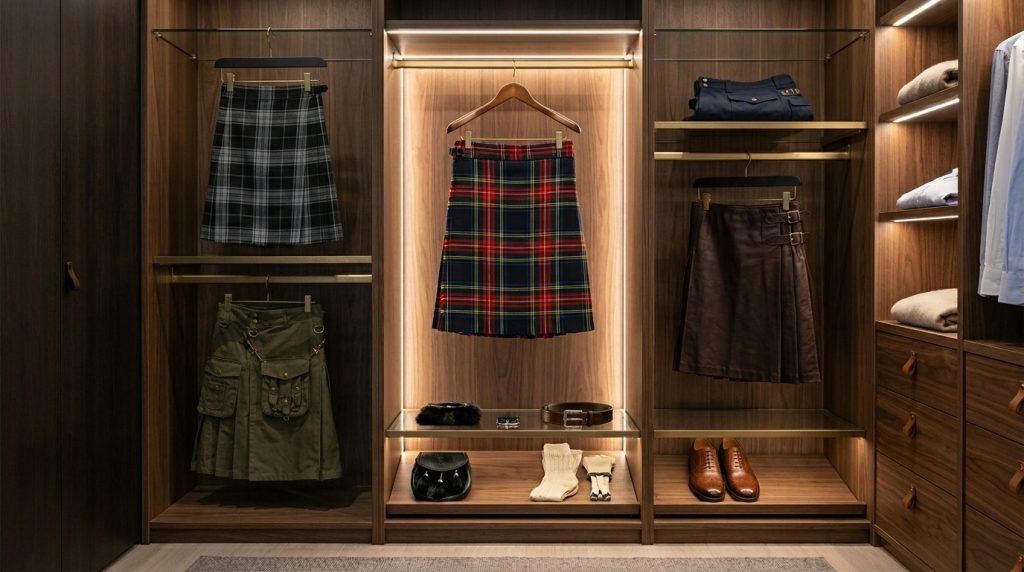
A complete, well-curated men kilt wardrobe might look like this:
1. Real tartan wool kilt — The foundation. Worn for weddings, Burns Night, funerals, formal Scottish events, photographs. Cost: $300-$500. Worn 8-15 times a year.
2. Utility kilt — Daily practical wear. Worn for errands, casual outings, light work. Cost: $80-$150. Worn 60-100 times a year.
3. Sport kilt (optional) — Athletic events, Highland Games athletic competitions, fun runs. Cost: $100-$160. Worn 5-15 times a year.
4. Second wool kilt in different tartan (optional) — For frequent kilt-wearers who want variety at formal events. Family clan tartan vs. Black Watch is a common second-pair. Cost: $300-$500. Worn 5-10 times a year.
5. Casual wool kilt or hybrid (optional) — Lighter weight wool or wool-blend for warmer weather and semi-formal events. Cost: $200-$350. Worn 5-15 times a year.
This is a complete wardrobe. Five pieces maximum. Each with a specific job. Total investment: $1,000-$1,800 over time.
The structure breaks down without the wool foundation. Add it, and the rest works.
How to Choose Your Foundational Wool Kilt
A few decisions to make:
Tartan choice. If you have clan heritage, lean toward your family tartan — even distant connections count. If not, Black Watch is the universal default and the most versatile across occasions. Royal Stewart is the second most common universal choice.
Weight. 13oz is the most versatile single weight if you can only own one. 16oz is more traditional and dramatic but warmer. 11oz is lighter and better in hot climates. For most American buyers, 13oz hits the sweet spot.
Yardage. 5-yard is fully presentable, manageable in weight, and more affordable. 8-yard is fully traditional, more dramatic in pleat depth, and more expensive. For your foundational kilt, 8-yard if budget allows. 5-yard if not.
Mill. Reputable Scottish mills include Lochcarron, House of Edgar, Strathmore, and Marton Mills. Vendors who can name the mill are usually selling authentic fabric. Vendors who can’t usually aren’t.
Maker. A few questions to ask any vendor: Can you size to my specific natural waist measurement? Are the pleats hand-stitched? Can you specify the wool weight and mill? If they answer all three confidently, you’re probably dealing with a real maker. If they evade or can’t answer, look elsewhere.
The Long-Term Math
The cost of a real wool kilt seems high at first glance. The math gets reasonable when you stretch it out.
A $400 wool kilt, properly cared for, lasts 30 years.
That’s $13.33 per year.
If you wear it just 5 times per year — weddings, Burns Night, cultural events, photographs — that’s $2.67 per wear over its lifetime.
You will never own another single piece of formal menswear with a cost-per-wear that low. A $1,000 suit worn 10 times a year for 10 years is $10 per wear. A $400 wool kilt worn 5 times a year for 30 years is under $3 per wear.
This is the financial argument for buying one real wool kilt instead of three cheap ones. The total spend is similar. The wear-life and quality are dramatically different.
Frequently Asked Questions
Will a wool kilt last 30 years really?
Yes, if cared for properly. Many wool kilts in active use are 40-50 years old. Some are heirlooms from a previous generation. Wool that’s stored well, cleaned appropriately, and worn carefully ages slowly.
Is a 5-yard wool kilt enough for formal events?
Yes. 5-yard wool kilts are fully appropriate for weddings, Burns Night, and most formal Scottish occasions. 8-yard is more traditional but not required.
What if I can’t afford $400 for a wool kilt?
Save up. The first wool kilt is a long-term investment. A $200 wool kilt may exist but is usually compromised on weight, mill, or construction. Better to wait six months and buy quality.
Can I get a wool kilt custom-made online?
Yes. Reputable vendors will take your measurements (natural waist, hip seat, length) and produce a custom kilt in 4-8 weeks. Communicate clearly about measurements and don’t rush.
How do I clean a wool kilt?
Dry-clean only by an experienced cleaner. Never machine wash. Spot-clean small marks immediately with cold water. Store properly with cedar or lavender for moth protection.
Is the Black Watch a good choice for a foundational wool kilt?
Excellent choice. It’s universal, versatile, photographs beautifully, and works for any event. If you can’t decide, default to Black Watch.
A men kilt wardrobe without a real wool kilt is incomplete in a way most owners don’t realize until they finally add one. Buy one good wool tartan kilt. Wear it for weddings, Burns Nights, and the events that matter. Let the rest of your kilt collection specialize. That’s how a kilt wardrobe is supposed to work.


